


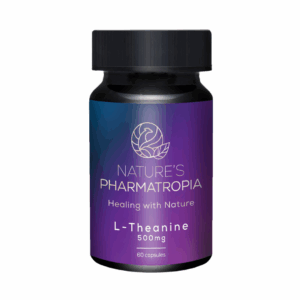

L-Theanine 500 mg Capsules
R287.50 incl. VAT
Brand: Natures PharmatropiaPotential uses and benefits
- Calm focus: may assist relaxed attention during demanding tasks.
- Everyday stress: human research explores possible short-term support for the stress response.
- Winding down and sleep: may assist some aspects of sleep quality; results vary.
500mg L-Theanine per capsule · 60 capsules.
Caffeine is not listed as an active ingredient. Capsule-shell material and the full excipient list are not confirmed in the reviewed label panels.
Research uses specific doses and preparations. Benefits of this finished product have not been established; 500mg is higher than several studied single doses.
View the supplier ingredient COA · Read directions and medicine cautions
L-Theanine 500mg – 60 Capsules
L-Theanine is an amino acid that occurs naturally in tea. This Nature’s Pharmatropia product declares 500mg per capsule in a 60-capsule bottle. It is considered for calm focus and an evening routine, with the research limits explained below.
Potential uses · Ingredients · Compare · Directions and safety · COAs and quality · Six human studies · Scientific papers · Guides · FAQs
Potential uses and what the evidence means
- Calm focus: may assist relaxed attention during demanding tasks.
- Everyday stress: human research explores possible short-term support for the stress response.
- Winding down and sleep: may assist some aspects of sleep quality; results vary.
“May assist” describes a possible role explored in ingredient research. It does not mean this capsule has been proven to treat anxiety, insomnia, depression or jet lag. Attention and sleep outcomes differ across studies, and greater strength does not establish a greater benefit.
Declared ingredients and product facts
- Active ingredient: L-Theanine, 500mg per capsule. The ingredient panel also names N⁵-ethyl-L-glutamine.
- Pack size: 60 capsules, as shown on the front label.
- Brand: Nature’s Pharmatropia.
- SKU: NP470-1-1.
- Capsule shell and other excipients: not specified in the reviewed label panels. Confirm the full current label for dietary or allergy requirements.
This is a declared L-theanine supplement, not a green-tea-extract product. Natural occurrence in tea does not establish that the ingredient was extracted from tea. Caffeine is not named as an active ingredient, and the supplier report is not a finished-product caffeine assay.
L-Theanine, magnesium or Lion’s Mane?
| Option | Ingredient focus | Useful comparison |
|---|---|---|
| L-Theanine | Relaxed attention, stress responses and sleep research | Actual theanine amount, preparation and suitability |
| Magnesium | An essential mineral with normal nutritional roles | Elemental magnesium, not only compound weight |
| Lion’s Mane | A mushroom with preliminary cognitive and mood research | Fruiting body/mycelium, extract details and batch evidence |
These are different ingredients, not interchangeable treatments. Compare Magnesium Glycinate or Lion’s Mane 600mg, 90 capsules. A combination is not automatically better or suitable for everyone.
Directions and safety
Check strength before use: one capsule contains a declared 500mg. Several human trials used about 100–400mg daily or a 200–250mg single dose, while other supervised studies used higher amounts. These protocols do not establish the best serving for this bottle.
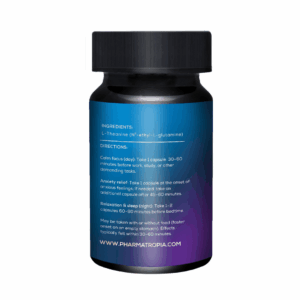
The photographed label gives separate daytime and evening directions, including a 1–2-capsule evening serving. That would represent 500–1,000mg, not the 200mg used in several trials. Confirm the appropriate serving and maximum daily intake with your pharmacist or practitioner, especially before repeating a dose. Do not divide a capsule by eye to imitate a research dose or use caffeine to compensate for insufficient sleep.
- Medicines and alcohol: discuss use with sedatives, sleep medicines, psychiatric medicines or other calming supplements. Additive drowsiness is possible; avoid driving if affected.
- Pregnancy, breastfeeding and children: suitability of this 500mg adult product is not established. Obtain individual professional advice.
- Medical conditions: seek advice if you have low blood pressure, take blood-pressure medicines, or are undergoing cancer treatment.
- Unwanted effects: stop and seek advice if headache, digestive upset or another adverse response occurs. Persistent sleep or anxiety symptoms deserve appropriate assessment.
This unregistered product has not been evaluated by SAHPRA for quality, safety or intended use. It is not intended to diagnose, treat, cure or prevent disease. Keep out of reach of children.
Supplier ingredient COA and what it establishes
Download the typical L-theanine supplier ingredient COA (PDF). It is a raw-material report supplied by Nautilus Chemicals, not a batch-matched or independently tested finished-capsule certificate.
- Issuer: Xintai Jiahe Biotech Co., Ltd; L-Theanine.
- Reference lot: T654-2602001; manufactured 6 February 2026; ingredient expiry 5 February 2028. These are ingredient-lot dates, not verified retail-stock dates.
- Assay: 99.8% against a 98.0–102.0% specification; specific rotation +8.3° within the stated range. This does not establish a measured 500mg amount in each finished capsule.
- Selected checks: loss on drying 0.09%; arsenic and cadmium each below 1ppm; mercury below 0.1ppm; E. coli and Salmonella reported not detected. The PDF gives the individual methods and remaining specifications.
Results belong to the named reference ingredient lot. They do not prove clinical benefit, current-capsule potency, zero contaminants, branded-ingredient licensing or the current bottle’s expiry. Consult the current bottle for batch and expiry information.
Read the quality-document explanation. The existing brand information flyer is background material, not a COA, peer-reviewed paper or dosing reference.
Six published human studies: relevance and limits
These are six ingredient studies, not six trials of Nature’s Pharmatropia’s finished 500mg capsules. Positive, mixed and negative findings are included. Branded research preparations and caffeine combinations are identified rather than assumed equivalent.
1. Hidese et al. (2019) · Everyday stress and sleep symptoms
Thirty adults without major psychiatric illness completed a randomized, blinded crossover trial of 200mg L-theanine daily or placebo for four weeks. Some sleep subscales and verbal-fluency findings favoured L-theanine, while several reported improvements were comparisons with baseline rather than clear superiority over placebo. The small study does not establish treatment of an anxiety disorder or show that this 500mg capsule produces greater benefits.
2. Kimura et al. (2007) · Responses to an acute stress task
Twelve participants underwent counterbalanced laboratory sessions involving L-theanine, placebo or no intervention during a mental-arithmetic stress task. Heart-rate and salivary immunoglobulin-A responses were reduced relative to placebo in this small experiment. These are short-term laboratory outcomes, not evidence that the supplement treats chronic anxiety or reliably changes everyday stress for every person.
3. Baba et al. (2021) · Attention and working memory
Sixty-nine adults aged 50–69 were initially enrolled and 50 were included in the final analysis. The study used about 100mg L-theanine per day, with testing after a single dose and after 12 weeks. Some attention and working-memory measures improved after the single dose; the longer intervention did not establish the same attentional benefit. This was a lower-dose branded preparation, not this 500mg capsule.
4. Moulin et al. (2024) · A 28-day trial with mixed results
Thirty moderately stressed adults received 400mg daily of the branded AlphaWave ingredient or placebo for 28 days. Perceived-stress and some attention scores improved from baseline, but the relevant between-group comparisons did not show superiority; cortisol changes also did not differ. Some sleep measures changed, including less time asleep, without a clear subjective-sleep advantage. Industry involvement, small groups and baseline differences limit interpretation. This bottle is not represented as AlphaWave.
5. Haskell et al. (2008) · L-theanine alone versus with caffeine
A blinded crossover trial tested 250mg L-theanine, 150mg caffeine, their combination and placebo. The combination improved selected attention and reaction-time measures, while L-theanine alone did not reproduce all those effects and increased headache ratings on one measure. Combination findings cannot be attributed to this caffeine-free ingredient listing or used as a recommendation to add caffeine.
6. Sarris et al. (2019) · A negative primary anxiety result
Forty-six adults with diagnosed generalized anxiety disorder received adjunctive L-theanine at 450–900mg or placebo alongside stable antidepressant treatment during an eight-week blinded period. L-theanine did not outperform placebo on the main anxiety or insomnia-severity outcomes. Some sleep-satisfaction findings were exploratory. This clinically supervised study argues against presenting L-theanine as a proven anxiety-disorder treatment or assuming higher doses work better.
Scientific reviews and technical background
- Williams et al. (2020): systematic review of stress and anxiety trials — reviews nine peer-reviewed reports and highlights the need for larger, longer studies.
- Bulman et al. (2025): sleep systematic review and meta-analysis — reports a possible benefit on selected subjective sleep outcomes, while noting limited evidence for pure L-theanine and uncertainty about dose and duration.
- Gerolymos et al. (2026): meta-analysis of 31 randomized trials — finds a short-term attention signal; stress effects were modest and influenced by bias, and anxiety findings were inconsistent. It does not establish this 500mg product’s benefit.
- Memorial Sloan Kettering: L-Theanine clinical monograph — professional safety and interaction background; not a product endorsement.
Reviews and technical background are separate from individual clinical studies. A marketing flyer is not counted as a scientific white paper.
Related guides
- L-Theanine: brand background article
- Combining sleep supplements: a safety and label checklist
- Excipients and capsule-shell information
- Supplement quality, COAs and traceability
The primary-study summaries above explain the evidence used for this product page; broader statements in background articles are not proof of this bottle’s effects.
Frequently asked questions
Does it contain caffeine?
Caffeine is not listed as an active ingredient. This is not a green-tea-extract supplement, and the available raw-material report is not a finished-capsule caffeine test.
Will it make me drowsy?
Responses vary. “Relaxed alertness” is a research topic, not a guarantee of no drowsiness. Take particular care with sleep medicines, alcohol and other calming products.
Is 500mg better than 200mg?
A higher amount has not been established as universally more effective. Many studies used lower amounts; confirm an appropriate serving rather than copying a study or repeatedly adding capsules.
Is it a proven anxiety or insomnia treatment?
No. Results are mixed, and a trial in diagnosed generalized anxiety disorder did not improve the main anxiety outcome compared with placebo.
Is it vegan or independently batch tested?
The capsule material is not confirmed in the reviewed panels, and the supplied COA covers a reference ingredient lot. Neither vegan status nor independent testing of the current finished capsules is established.
Evidence and product-information check
Checked 11 November 2026. Study protocols are not product dosing instructions. Our Editorial and Evidence Policy explains how ingredient research differs from evidence for a finished product. Read the current label and discuss suitability with an appropriately qualified healthcare professional.
| Weight | 0.08 kg |
|---|---|
| Dimensions | 5.5 × 5.5 × 9.5 cm |
| Pack size | 60 capsules |
| Declared active ingredient | L-Theanine |
| Declared amount | 500mg per capsule |
| Capsule shell | Not confirmed in reviewed label panels |
Only logged in customers who have purchased this product may leave a review.




Reviews
There are no reviews yet.