
NATURE’S PHARMATROPIA / THE COMPLETE GUIDE
Methylene Blue
in South Africa.
A remarkable history. Fascinating science.
A clearer way to make an informed choice.
Explore how methylene blue works, what the research actually shows, and why quality and personal suitability matter. Then compare our complete current range.
16mg · 25mg · 100mg capsules & selected bundles
THE PHARMATROPIA COLLECTION
Clearly labelled.
Thoughtfully chosen.
USP-grade raw-material specification.
Quality documentation available.
SHOP THE COMPLETE COLLECTION
Buy Methylene Blue
from Pharmatropia.
Compare the four current capsule options below. Prices and purchase controls come directly from our shop. Choose a strength only after checking personal suitability, the product label and the relevant product information.
16mg / 60 CAPSULES
Lower-strength format in the range.
25mg / 60 CAPSULES
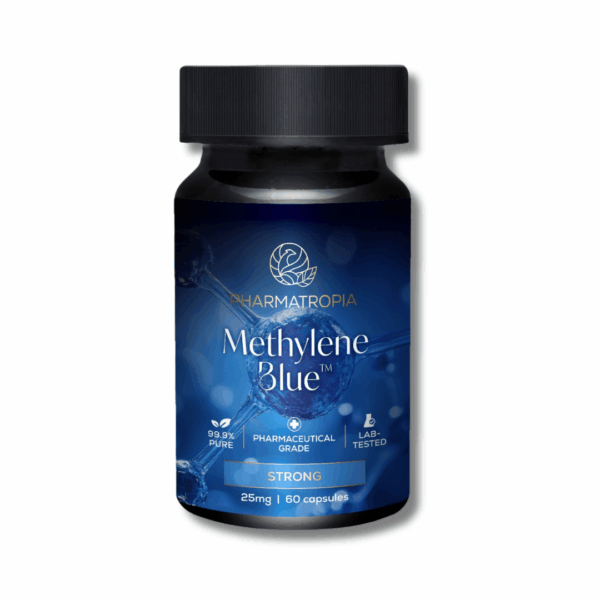
25mg per capsule in a 60-count bottle.
25mg / 120 CAPSULES
The same strength in a larger pack.
100mg / 30 CAPSULES
Highest strength. Professional guidance.


Explore the methylene blue bundles
Each bundle contains additional products. Read every ingredient and interaction warning; a bundle is not evidence that its components should be taken together or are suitable for everyone.


Educational information only. This guide is not personal medical advice. Ingredient research does not establish that these products diagnose, treat, cure or prevent disease. Current labels, individual product information and qualified medical guidance take priority.
CLEAR PRODUCT INFORMATION
Strength, pack size and composition.
QUALITY YOU CAN QUESTION
Ask for batch-relevant documentation.
SOUTH AFRICAN DELIVERY
Current prices and stock from our shop.
01 / THE FOUNDATIONS
What is
methylene blue?
Methylene blue, also called methylthioninium chloride, is a synthetic compound with a distinctive blue colour and a long history in laboratories and medicine. Its ability to accept and donate electrons is central to both its established medical applications and its newer research possibilities.
In clinical medicine, an approved intravenous formulation is used for acquired methaemoglobinaemia, a condition that affects the blood’s ability to carry oxygen. This specific medical use is different from buying an oral wellness product. Clinical safety source
Today, researchers are investigating its effects on cellular energy, oxidative stress and brain metabolism. This guide brings together the subjects explored on our Methylene Blue Info education website and links directly to the evidence behind them.
1876
From a blue dye
Heinrich Caro first synthesised methylene blue. Its vivid colour brought it into chemistry and microscopy.
1891
Into medical history
Paul Ehrlich’s early work investigated methylene blue against malaria, an important chapter in synthetic drug development.
TODAY
A continuing question
Established clinical applications sit alongside active research into mitochondria, cognition and cellular ageing.
Explore the fuller history · Research findings depend on formulation, dose, route and study population.
02 / CELLULAR SCIENCE
Why mitochondria
are part of the story.
Mitochondria help convert energy from food into ATP, the usable energy that powers many cellular processes. Their electron transport chain passes electrons through a series of reactions. Methylene blue can participate in electron transfer, which is why it attracts interest in energy-metabolism research. Mechanism review
01 / ELECTRON TRANSFER
Accept. Donate. Repeat.
Methylene blue can cycle between oxidised and reduced forms. In experimental systems, this redox behaviour can influence mitochondrial respiration.
02 / OXIDATIVE BALANCE
Context changes the effect.
Researchers study how it influences reactive oxygen species. Effects depend on concentration and conditions; it can behave differently at higher exposure or with light activation.
03 / THE BRAIN
High energy demands.
The brain’s energy needs and methylene blue’s ability to enter the central nervous system have prompted studies of memory and neural metabolism.
The practical distinction: a plausible mechanism helps explain why a molecule is studied. It does not, by itself, prove an everyday benefit from a particular capsule.
03 / THE EVIDENCE
What does the
research actually show?
Interest in methylene blue spans several fields. Read the study type first: a small human trial, a review, an animal experiment and a cell-culture study answer very different questions.
ESTABLISHED MEDICAL USE
Specific medicines, clinical indications and supervised administration.
EARLY HUMAN RESEARCH
Interesting signals that still need larger, longer studies.
PRECLINICAL RESEARCH
Laboratory and animal findings that cannot establish a benefit in people.
HUMAN TRIAL / RADIOLOGY, 2016
Attention & short-term memory
A randomised, double-blind study enrolled 26 healthy adults and investigated a single oral dose using brain imaging and memory tasks. It reported changes in task-related brain activity and a memory-retrieval signal.
Keep in perspective: a small, single-dose experiment does not establish long-term effectiveness, a daily wellness dose or a result from Pharmatropia capsules. [3]
REVIEW / PROGRESS IN NEUROBIOLOGY, 2012
Brain energy metabolism
Rojas and colleagues reviewed redox behaviour, mitochondrial mechanisms and memory research. Their paper helps explain the interest in methylene blue as a neurological research tool.
Keep in perspective: mechanistic and preclinical findings do not establish treatment for Alzheimer’s or Parkinson’s disease. [2]
CELL STUDY / REDOX BIOLOGY, 2015
Cellular ageing pathways
Atamna and colleagues investigated energy metabolism, cellular defence and senescence in laboratory cell systems. This is one reason methylene blue appears in longevity discussions.
Keep in perspective: effects in cultured cells do not show that oral methylene blue extends human lifespan. [4]
LABORATORY STUDY / SCIENTIFIC REPORTS, 2017
Skin & oxidative stress
Researchers studied human skin fibroblasts and reconstructed skin models, examining oxidative stress and ageing-related changes.
Keep in perspective: these laboratory findings are not clinical evidence that oral capsules reverse skin ageing. [5]
PRECLINICAL STUDY / PLOS ONE, 2012
Neuroprotection under study
Poteet and colleagues compared methylene blue and related compounds in experimental models involving mitochondrial function and oxidative stress.
Keep in perspective: this supports further research, rather than a claim that retail capsules prevent neurological disease. [6]
SPECIALIST RESEARCH / 2023–2024
Photodynamic therapy & tumour oxygenation
Separate research explores methylene blue as a light-activated photosensitiser and its effects on tumour oxygenation. The 2024 oxygenation study used a mouse tumour model.
Keep in perspective: this does not establish oral capsules or home red-light treatment as cancer therapy. [7, 8]
Our education site also explores mood, metabolic health and eye health. These remain research topics; none should be read as a guaranteed outcome or a reason to replace prescribed treatment. The sources below let you explore the original papers.
04 / QUALITY & FORMATS
The label is
only the beginning.
When choosing methylene blue, the useful questions are about identity, composition, traceability and the evidence behind a quality claim.
What does USP grade mean?
USP refers to standards published by the United States Pharmacopeia. A raw-material specification is a quality statement; it is separate from approval of a finished product for a medical indication.
What should a quality document tell you?
Look for the substance and batch tested, the test methods, the results and the limits used. Check whether the report applies to the raw ingredient or to the finished capsules. A report only supports what it actually tested.
What does Pharmatropia provide?
Our current product listings describe USP-grade raw material and independent batch testing. The range has clearly stated strengths and product-information PDFs. For batch-specific documents or composition questions, contact our team before you choose.
Capsules
A declared amount per capsule makes strengths and pack sizes easy to compare. Read the active ingredient, excipients and capsule-shell information. A fixed-strength capsule still needs to be appropriate for the person using it.
Liquid solutions
The concentration must be clear in milligrams per millilitre. Drop size varies, so “one drop” is not a universal dose. Liquids can stain teeth, skin, clothing and surfaces. Aquarium and industrial products are unsuitable for human use.
Read the product information
05 / SUITABILITY & DOSAGE
An informed choice
starts with suitability.
There is no established universal oral dose for healthy ageing, memory or general wellness. A study dose, an intravenous treatment dose and the strength printed on a capsule answer different questions. Do not turn an online mg/kg range or a drop-count example into a personal prescription.
Medicine interactions
Methylene blue inhibits monoamine oxidase and can cause serious serotonin toxicity when combined with serotonin-affecting medicines. Antidepressants, some opioids and dextromethorphan are important examples. Ask the prescribing clinician or pharmacist to check all medicines and supplements; do not stop prescribed treatment yourself. [1]
Who needs extra care?
Do not use with G6PD deficiency or a known severe methylene blue allergy. Pregnancy, breastfeeding, kidney disease and complex medical conditions need individual medical assessment. The 100mg capsule is the highest-strength option in this range and should be considered only with appropriate professional guidance. [1]
Blue or green urine can occur. Nausea, dizziness and other adverse effects are also possible. Seek urgent help for severe allergic symptoms or symptoms suggesting serotonin toxicity, such as agitation, fever, tremor and muscle rigidity after combining products. [1]
06 / THE VIDEO LIBRARY
Make space for
a deeper conversation.
All four videos linked on our Methylene Blue Info site, gathered in one place. Press play here, or watch directly on YouTube.
Video titles are those used by the source library. Speakers’ opinions and clinical discussions may go beyond established evidence and are not personal medical advice or proof of a product benefit.
07 / QUESTIONS & ANSWERS
The questions
worth asking.
Clear answers about science, quality, formats and buying methylene blue in South Africa.
What is methylene blue?
Methylene blue, also called methylthioninium chloride, is a synthetic compound used in laboratories and in specific clinical settings. Its redox properties are also studied in cellular-energy and brain-metabolism research.
How does methylene blue work in mitochondria?
It can accept and donate electrons and cycle between oxidised and reduced forms. Researchers study how this influences mitochondrial respiration and oxidative balance. Experimental mechanisms do not establish an everyday benefit from a particular capsule.
Is methylene blue proven to improve memory or longevity?
Small human studies have reported interesting memory and brain-imaging findings, while longevity claims largely draw on preclinical research. This does not establish long-term cognitive improvement or a longer lifespan from oral wellness products.
Is there a recommended daily wellness dose?
There is no established universal oral wellness dose. Personal suitability depends on medicines, health history, formulation and professional assessment. Do not use a general online mg/kg range as a personal dosing instruction.
How do 16mg, 25mg and 100mg capsules differ?
The number describes the declared amount of methylene blue per capsule. Pharmatropia lists 16mg in 60 capsules, 25mg in 60 or 120 capsules, and 100mg in 30 capsules. More milligrams are not automatically more suitable; the 100mg format needs appropriate professional guidance.
Are the two 25mg pack sizes the same strength?
Yes. Both declare 25mg per capsule. The difference is the number of capsules in the bottle: 60 or 120. Compare the current label, composition and live price on the product page.
What does USP grade mean?
USP describes recognised quality specifications. A USP-grade raw-material claim is separate from approval of a finished capsule for a medical indication. Check the actual quality documents and which batch and material they cover.
Can I see the quality documents and product PDFs?
Product-information PDFs for the 16mg, 25mg and 100mg formats are linked above. The product pages describe available testing information. Contact Pharmatropia for batch-specific documentation and check that it matches the bottle you are buying.
Can methylene blue interact with antidepressants?
Yes. There is a serious risk of serotonin toxicity with serotonin-affecting medicines. Ask the prescribing clinician or pharmacist to assess all medicines and supplements before considering methylene blue. Do not stop a prescribed medicine to take it.
Who should avoid methylene blue?
People with G6PD deficiency or a severe methylene blue allergy should not use it. Pregnancy, breastfeeding, kidney disease and other medical conditions require individual medical guidance. Check interactions before buying any strength.
Why can urine turn blue or green?
Methylene blue can colour urine blue or green. Colour change is not a measure of purity, effectiveness or whether a dose is right for you. Unexpected or concerning symptoms need appropriate medical assessment.
Can I use aquarium or industrial methylene blue?
No. Those products are intended for other uses and may have inappropriate impurities, additives or quality controls. They should not be used as substitutes for products intended for human use.
Can I combine methylene blue with red-light therapy?
Some research investigates controlled light activation or photobiomodulation. A research protocol is different from combining retail capsules with a home light device. This page does not recommend a home treatment protocol.
Where can I buy methylene blue in South Africa?
You can compare the current Pharmatropia capsule range and selected methylene blue bundles in the shopping section near the top of this page. The shop supplies live prices, stock information and purchase controls. Delivery options and charges are shown at checkout.
THE READING LIST
Follow the evidence.
- 1. Clinical indication, contraindications & interactions
FDA: PROVAYBLUE prescribing information (2023). This label concerns an intravenous medicine, not approval of these capsules. - 2. Neurometabolic mechanisms
Rojas, Bruchey & González-Lima. Progress in Neurobiology (2012). - 3. Human brain imaging & memory
Rodriguez et al. Multimodal randomised functional MR imaging study. Radiology (2016). - 4. Energy, cellular defence & senescence
Atamna et al. Redox Biology (2015). - 5. Human skin models
Xiong et al. Scientific Reports (2017). - 6. Experimental neuroprotection
Poteet et al. PLOS ONE (2012). - 7. Tumour oxygenation in mice
Pominova et al. Photodiagnosis and Photodynamic Therapy (2024). - 8. Anticancer photodynamic research
Systematic review of preclinical studies. Frontiers in Pharmacology (2023).
Source themes and video selection: methylene-blue.co.za. Published by Nature’s Pharmatropia. Updated 9 October 2026. Our editorial & evidence policy.