
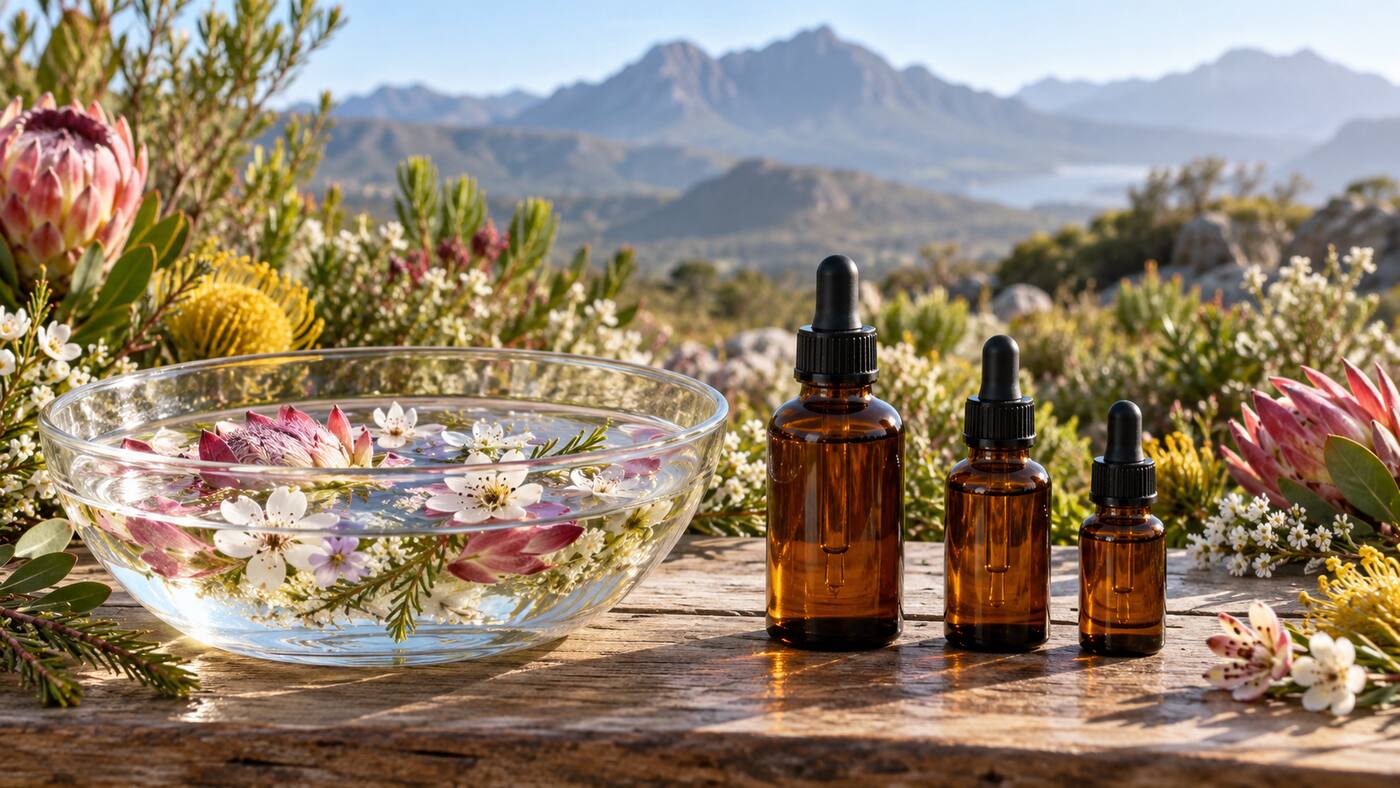
Mother Essence, Stock Bottle and Dosage Bottle: What’s the Difference?
Written by Lize Bührmann, founder of Pharmatropia.
In flower-essence practice, “mother”, “stock” and “dosage” usually describe successive preparation levels. A mother essence is the original preparation, a stock bottle is made from it for storage and dispensing, and a dosage or treatment bottle is a further dilution prepared for regular use. These are tradition-specific terms—not measures of herbal constituent concentration.
Practices vary between essence makers, so the producer’s own directions take priority.
What is a mother essence?
The mother essence is the first preparation associated with the chosen flower and water. In commonly described sun or boiling methods, blossoms are placed in or above water under defined conditions, then removed. A preservative may be added afterwards.
This stage carries the source and preparation identity within the essence-making tradition. It should not be confused with a herbal mother tincture: a tincture is an extract containing measurable plant constituents, while a flower essence is generally prepared and described as a vibrational product. Read vibrational essence vs herbal tincture for the important distinction.
What is a stock bottle?
A stock bottle is prepared from the mother essence, usually with water and a preservative such as brandy or glycerine. Producers commonly sell single essences at stock strength because the bottle is stable and convenient for dispensing.
“Stock” does not automatically mean “take a large dose”. It means this bottle is the working supply from which a dosage bottle or glass of water may be prepared. Follow the specific label because drop counts and preservatives differ.
What is a dosage or treatment bottle?
A dosage bottle is a further preparation made from one or more stock essences. It usually contains mostly water, a small amount of stock essence and, where appropriate, a preservative. It is intended for repeated individual use over a shorter period.
Hygiene matters. Use a clean bottle, avoid touching the dropper to the mouth or skin, label the blend with ingredients and date, and discard it if the appearance, smell or cleanliness changes.
Do repeated dilutions make an essence chemically stronger?
No. Flower-essence traditions do not use these stages as a conventional concentration scale. A dosage bottle contains less source preparation by volume than a stock bottle. Claims about emotional or energetic effects belong to traditional or spiritual practice and should not be presented as established pharmacology.
A systematic review of controlled Bach flower-remedy trials did not find reliable evidence of benefit beyond placebo. People may still use essences as reflective or ritual supports, but that experience should remain distinct from evidence for treating a health condition.
How are combination bottles made?
Practitioners may select several stock essences to create a personalised dosage bottle. More ingredients do not necessarily make a blend more complete. A small, clearly documented selection makes it easier to understand the intention and to review the experience.
Ask:
- Which exact essences are included?
- Is this a stock or dosage bottle?
- What preservative is used?
- How should it be stored and for how long?
- Is it intended for oral, topical or environmental use?
- Does it contain alcohol, glycerine or another ingredient that matters to me?
Flower, gem and environmental essences
The same mother–stock–dosage language may be used for other vibrational preparations, but production methods and traditions differ. Our guide to flower, gem and environmental essences compares their stated sources without treating them as interchangeable medicines.
Safety and responsible use
Check alcohol content before use in children, pregnancy, breastfeeding, liver disease, medicine regimens, recovery from alcohol dependence or any setting where alcohol must be avoided. “Only a few drops” does not answer every personal safety concern.
Do not use an essence to delay diagnosis or replace effective care. For severe anxiety, depression, trauma symptoms, self-harm thoughts or a sudden change in functioning, seek qualified support. A reflective practice can accompany care; it is not a substitute for it.
Frequently asked questions
Can I take drops directly from a stock bottle?
Some makers allow it, while others expect stock drops to be diluted. Follow that product’s label and avoid assuming all brands use the same strength or preservative.
How many stock essences can go into one dosage bottle?
There is no scientifically established ideal number. Practitioners often favour a focused selection based on a clear intention rather than adding many overlapping essences.
Does a dosage bottle need refrigeration?
It depends on its preservative, climate and maker’s instructions. Water-rich, minimally preserved bottles can spoil more quickly in South African heat.
Are flower essences the same as essential oils?
No. Essential oils contain concentrated volatile aromatic compounds and have different dilution and safety requirements. See flower essences vs essential oils.
Educational note: This article distinguishes traditional practice from clinical evidence. It does not claim that essences diagnose, prevent or treat disease.