
L-Citrulline vs Citrulline Malate: What’s the Difference?
Written by Lize Bührmann, founder of Pharmatropia.
Short answer: L-citrulline provides the amino acid on its own, while citrulline malate combines citrulline with malate. Both are marketed for nitric-oxide support and exercise performance, but a gram of citrulline malate is not necessarily a gram of L-citrulline. The better choice is the product that clearly states how much actual L-citrulline it provides and suits your intended use.
Labels make this comparison harder than it should be. Some products state a ratio such as 2:1, others list only a total amount, and research does not always verify the finished product’s composition.
What is L-citrulline?
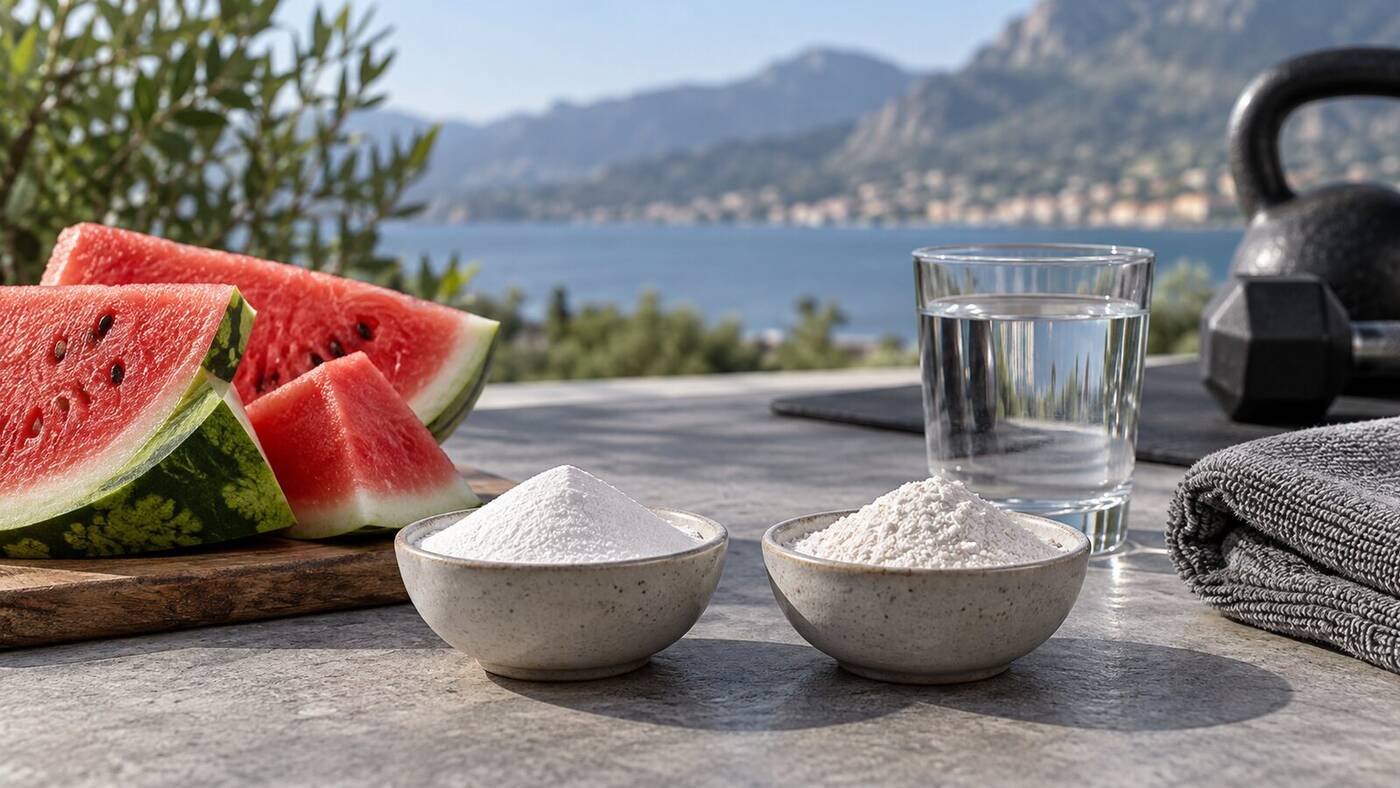
L-citrulline is an amino acid found naturally in foods such as watermelon. In the body, it can be converted to L-arginine, which contributes to nitric-oxide production. Nitric oxide helps regulate blood-vessel tone, but a biochemical pathway does not guarantee a noticeable performance effect for every person.
The US National Institutes of Health notes that research on performance supplements varies by ingredient, dose, sport and study design. Its exercise and athletic performance fact sheet is a useful evidence-based starting point.
What is citrulline malate?
Citrulline malate is a blend or compound of citrulline and malate, a form related to malic acid. Malate participates in cellular energy pathways, which is one reason the combination is promoted for training. However, the clinical evidence does not clearly show that the malate portion makes every product superior to pure L-citrulline.
A critical review of citrulline-malate research found important uncertainties around product composition and the independent contribution of malate. Read the peer-reviewed review indexed by PubMed.
How ratio labels change the maths
A “2:1” label generally describes two parts citrulline to one part malate by weight. On that basis, 6 g of the combined material would theoretically contain about 4 g citrulline and 2 g malate. But that calculation is only as reliable as the product’s identity, manufacturing controls and label accuracy.
Do not compare scoop weight alone. Compare the declared amount of actual L-citrulline per serving. If the label gives only “citrulline malate 6 g” without a ratio or citrulline yield, you cannot make a precise like-for-like comparison.
L-citrulline vs citrulline malate at a glance
| Question | L-citrulline | Citrulline malate |
|---|---|---|
| What is it? | The amino acid itself | Citrulline combined with malate |
| Label clarity | Usually easier to quantify | Requires a clear ratio or citrulline yield |
| Taste | Generally mild | Often more tart or acidic |
| Research | Studied for nitric-oxide pathways and exercise | Studied mainly in exercise settings, with variable formulations |
| Best comparison | Actual L-citrulline per serving | Actual L-citrulline per serving, not total blend weight |
Which one should you choose?
Choose pure L-citrulline when you want straightforward label maths and control over the amount of the amino acid. Citrulline malate may suit someone who prefers its tart taste or wants a combined pre-workout ingredient, provided the ratio and actual citrulline content are transparent.
Neither form is automatically “stronger”. Your training status, diet, product quality and total programme matter more than a fashionable label. If you are also comparing pathways, see L-arginine vs L-citrulline and beetroot vs L-citrulline.
What to check on a South African supplement label
- The exact ingredient name and amount per serving.
- For citrulline malate, the stated ratio or L-citrulline yield.
- The serving size and number of servings, not only the front-label scoop claim.
- Other active ingredients, especially caffeine or stimulant blends.
- Batch number, expiry information, manufacturer or importer details and credible quality documentation.
- Warnings relevant to medicines, blood pressure, pregnancy and medical conditions.
If a product sits inside a broader performance formula, our nitric oxide supplement vs pre-workout guide helps separate circulation-focused ingredients from stimulant effects.
Safety considerations
Citrulline is generally studied as a dietary supplement, not as a replacement for cardiovascular treatment. Because it may affect nitric-oxide pathways and blood pressure, ask a clinician before use if you take blood-pressure medicines, nitrates, phosphodiesterase-5 inhibitors or have cardiovascular or kidney concerns. Stop and seek advice for significant dizziness, fainting, chest symptoms or an allergic reaction.
Frequently asked questions
Is citrulline malate the same as L-citrulline?
No. It contains L-citrulline plus malate, so the total powder weight includes both components.
Does 6 g of citrulline malate equal 6 g of L-citrulline?
No. The actual citrulline amount depends on the blend ratio and whether the label accurately reflects the finished product.
Is a 2:1 ratio always better than 1:1?
Not automatically. A 2:1 ratio generally provides a larger citrulline share by weight, but “better” depends on the actual amount, formulation quality and intended use.
Can I use either product without training?
These ingredients are often marketed for exercise, but they do not replace training, sleep, nutrition or medical care. Discuss non-sport use with a qualified professional.
Educational disclaimer: This article provides general information, not personalised sports-nutrition or medical advice. Competitive athletes should also verify products against their sport’s anti-doping requirements.