
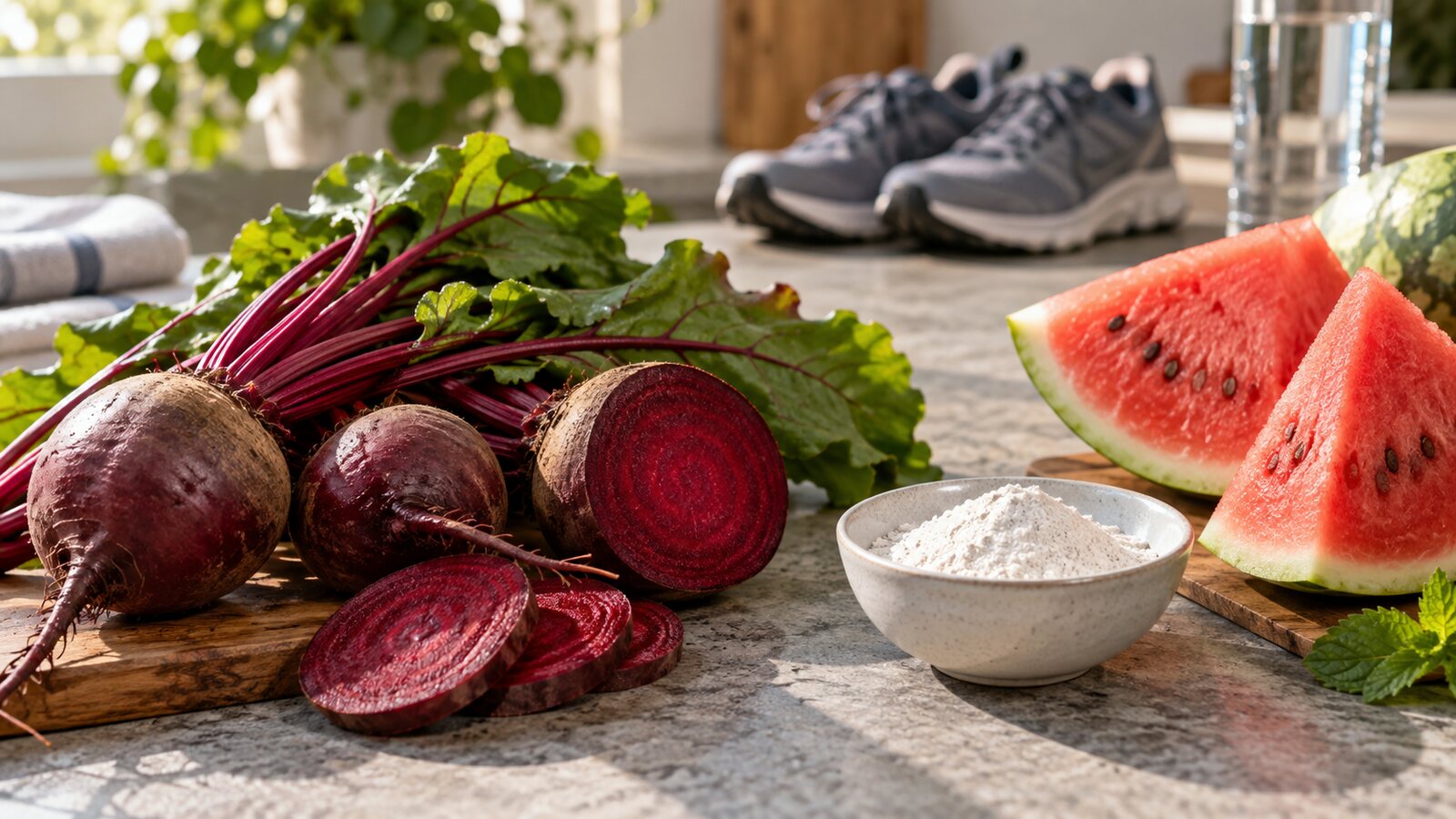
Beetroot vs L-Citrulline for Nitric Oxide: What’s the Difference?
Beetroot and L-citrulline may both support nitric-oxide production, but they use different biological routes. Beetroot supplies dietary nitrate, which can be converted through the nitrate–nitrite–nitric oxide pathway. L-citrulline is converted to L-arginine, which the body can use in its nitric-oxide synthase pathway. Neither option guarantees a better workout, “pump”, circulation result or blood-pressure outcome.
For a South African shopper, the practical choice depends on the labelled ingredient and amount, the goal, evidence for the exact format, medication and blood-pressure considerations, and tolerance.
How beetroot supports nitric oxide
Beetroot is a food source of inorganic nitrate. Oral bacteria help convert nitrate to nitrite, and further conversion can contribute to nitric oxide—especially in conditions where oxygen availability is lower.
The NIH Office of Dietary Supplements reports that beetroot juice or concentrate has improved some endurance and exercise outcomes in studies, although not every trial shows a benefit and responses differ between recreational and elite athletes. Nitrate content can also vary substantially between products.
A systematic review and meta-analysis of 73 studies found benefits for selected performance outcomes such as time to exhaustion and power output, while several other outcomes did not improve significantly. That is a useful example of why “some evidence” is more accurate than “works for everyone”.
How L-citrulline supports nitric oxide
L-citrulline is an amino acid that the body converts to L-arginine. Arginine can then be used to produce nitric oxide. Citrulline is often sold on its own or as citrulline malate in pre-workout products.
Research is mixed. The NIH consumer guidance notes that the evidence for performance improvement remains limited, while a critical review of citrulline malate found inconsistent results and highlighted differences in dose, exercise protocols and product quality. Citrulline and citrulline malate should not be treated as identical merely because both labels include the word “citrulline”.
Beetroot versus L-citrulline at a glance
| Question | Beetroot / nitrate | L-citrulline |
|---|---|---|
| Primary route | Nitrate → nitrite → nitric oxide | Citrulline → arginine → nitric oxide |
| Typical format | Food, juice, concentrate or powder | Amino-acid powder or capsule |
| Label detail that matters | Actual nitrate amount, not only “beetroot” weight | Amount of L-citrulline and whether it is pure citrulline or citrulline malate |
| Evidence picture | Some support for selected endurance outcomes | Mixed and product-dependent |
| Common practical issue | Taste, sugar content, red urine or stool | Gastrointestinal discomfort in some users |
Do not compare products by front-label milligrams alone
A beetroot powder can list several grams of beetroot without declaring nitrate. That does not tell you whether it provides an amount comparable with research. Likewise, a “nitric oxide matrix” may combine citrulline, arginine, plant powders and flavouring without giving the individual amount of each ingredient.
Before buying, check:
- the exact ingredient form and amount per serving;
- whether a proprietary blend hides the component doses;
- servings per container and cost per labelled serving;
- batch number, expiry date and responsible supplier;
- added caffeine, sweeteners or stimulants;
- warnings for medication, pregnancy and health conditions.
Our broader guide to nitric oxide supplements in South Africa explains common ingredients and safety questions. Product selection should be based on the current label, not a general article or social-media promise.
Which one is better for exercise?
There is no universal winner. Beetroot nitrate currently has a clearer evidence base for certain endurance contexts, particularly in recreationally active people, but results vary. Citrulline may be chosen for resistance-training or pre-workout routines, yet the research is inconsistent and product composition matters.
Food foundations remain important: regular exercise, adequate sleep, sufficient energy and protein, vegetables, hydration and appropriate recovery will matter more than a single nitric-oxide product.
Important safety questions
Both approaches can affect vascular tone, and some users experience digestive symptoms. Seek professional advice before use if you take blood-pressure medicine, nitrates for chest pain, medicines for erectile dysfunction, or have cardiovascular, kidney or significant gastrointestinal concerns. Do not use a supplement to self-treat chest pain, unexplained breathlessness or circulation symptoms.
Antibacterial mouthwash can alter oral bacteria involved in nitrate conversion; this is scientifically interesting, but it is not a reason to abandon medically or dentally indicated oral care. Discuss your circumstances with an appropriate professional.
Frequently asked questions
Is beetroot powder the same as beetroot juice concentrate?
No. Formats and nitrate content vary. Look for a declared nitrate amount and evidence relevant to that format rather than assuming equal servings are interchangeable.
Is L-arginine the same as L-citrulline?
No. They are related amino acids, but oral absorption and metabolism differ. A label should state which one is present.
Can I combine beetroot and L-citrulline?
Combination is not automatically better and may increase cost or unwanted effects. Discuss stacking with a qualified professional, especially if you use medicines that influence blood pressure.
Will nitric-oxide supplements treat high blood pressure?
They are not a replacement for diagnosis or prescribed treatment. Blood-pressure concerns require proper measurement and clinical care.
Educational information only and not medical advice. Follow the product label and consult a healthcare professional when medicines or health conditions are involved.
Written by Lize Bührmann, founder of Pharmatropia.
Compare Nitric Oxide Supplements in South Africa
For the full ingredient and buying comparison, visit the Nitric Oxide Supplements South Africa hub. You can also view the 120-capsule L-Arginine, L-Citrulline Malate and L-Ornithine AKG formula.
Further reading and editorial review
Continue with the Nitric Oxide Supplements South Africa guide and the L-Arginine vs L-Citrulline comparison.
Author and review: Written and reviewed for responsible product information by Dr Lize Buhrmann, Doctor of Natural Medicine and postgraduate-trained in Phytomedicine.
Evidence standard: General ingredient research is not presented as proof for a specific finished product. Read Pharmatropia’s Editorial & Evidence Policy.