Blue Lotus Tea vs Tincture: What’s the Difference?
Written by Lize Bührmann, founder of Pharmatropia.
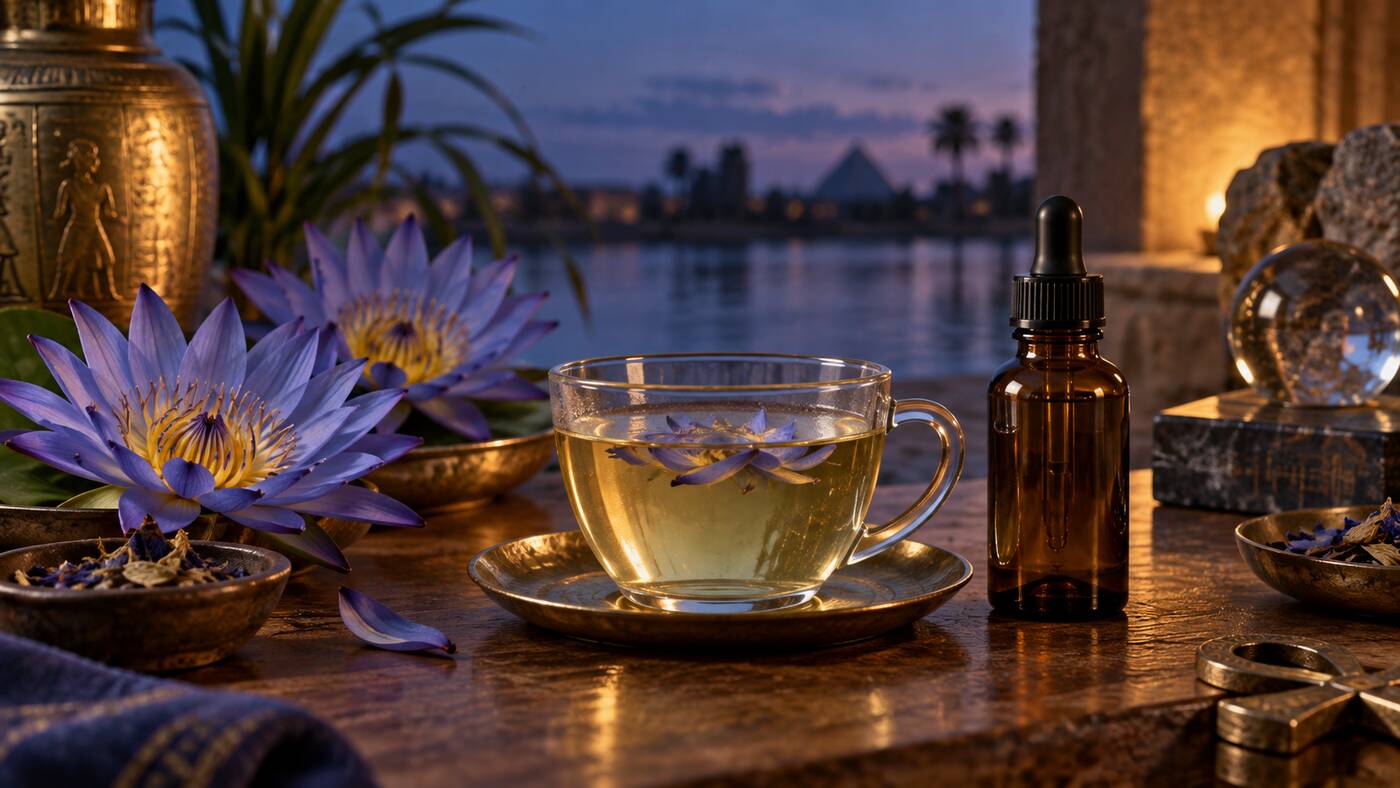
Short answer: blue lotus tea is a short water infusion of flower material, while a tincture is a concentrated liquid extract made with a solvent such as alcohol or glycerol. They are not equivalent serving for serving. The better option depends on the exact species, product specification, your reason for using it and whether alcohol or concentrated extracts are appropriate for you.
Neither form should be described as automatically safer, stronger or more traditional without knowing how it was made.
Start with the botanical name
“Blue lotus” is used commercially for more than one water-lily species. Egyptian blue lotus is commonly identified as Nymphaea caerulea, while Indian blue lotus may be labelled Nymphaea nouchali. These names should not be treated as interchangeable.
Check the Latin binomial, plant part and country of origin. Whole flowers also give you a visual starting point, but appearance alone cannot confirm species or purity.
How tea and tincture differ
| Question | Blue lotus tea | Blue lotus tincture |
|---|---|---|
| Preparation | Flower material steeped in hot water | Plant material extracted into alcohol, glycerol or another declared solvent |
| Extraction time | Minutes | Usually a longer manufacturing process |
| Concentration | Depends on flower amount, water and steeping | Depends on extract ratio and process |
| Measurement | Cup and plant quantity | Measured in millilitres; drops are variable |
| Other ingredients | Usually only plant and water | Solvent, preservatives or flavouring may be present |
Is a tincture always stronger?
No. “Tincture” tells you the dosage form, not the finished concentration. To compare products, look for an extract ratio, starting material, solvent percentage and serving size. A tea can also be made more concentrated by using more plant material or less water, but that does not make it equivalent to a specified extract.
Read what tincture ratios mean and what alcohol percentage means in a tincture before comparing numbers.
What does the evidence say about blue lotus?
Human clinical evidence is limited. Chemical analyses have identified alkaloids in some Nymphaea caerulea products, but commercial products can vary. A published case series described five people who developed sedation and perceptual disturbances after ingesting or inhaling blue-lotus products; four had vaped products and one used an infused beverage. A case series cannot establish the usual risk of tea or tincture, but it shows why concentrated or inhaled preparations should not be treated casually. For possible medicine interactions and why evidence remains limited, read our Blue Lotus medicine-interaction guide.
See the blue-lotus toxicity case series. It does not prove that an ordinary cup of correctly identified tea will cause the same effects.
How to choose between tea and tincture
Tea may suit you when:
- you prefer a slow, sensory ritual;
- you want to see the plant material;
- you wish to avoid alcohol;
- you can follow a clearly stated preparation method.
A tincture may suit you when:
- you need a portable, measured liquid format;
- the label clearly states species, solvent, ratio and serving;
- you are comfortable with the alcohol or glycerol content;
- a practitioner has reviewed its suitability.
View the current Blue Lotus tea or 10ml tincture product information before comparing options.
For history, traditional context and modern safety boundaries, read Blue Lotus: History, Traditional Use and Modern Safety.
Important safety considerations
Avoid combining blue lotus with alcohol, cannabis, sedatives or other products that impair alertness. Do not drive or operate machinery if you feel drowsy or altered. Pregnancy, breastfeeding, adolescence and significant medical or psychiatric conditions require professional guidance because safety information is limited.
Do not vape or smoke a product merely because the same plant is also sold as tea. Heating and inhalation create a different exposure with different risks.
Frequently asked questions
How many drops equal one cup of blue lotus tea?
There is no universal conversion. The extract ratio, solvent, dropper and tea preparation all vary.
Is blue lotus tincture alcohol-free?
Not necessarily. Traditional tinctures commonly use alcohol, while glycerites use glycerol. Check the full label rather than assuming.
Can blue lotus tea help sleep?
Some people use it as part of an evening ritual, but clinical evidence for treating insomnia is insufficient. It should not replace assessment of persistent sleep problems.
Is blue lotus the same as blue pea tea?
No. Blue pea is usually Clitoria ternatea; blue lotus products use a Nymphaea species. They have different botanical identities and traditions.
Educational disclaimer: This article is general education and does not recommend blue lotus to treat a health condition. Product identity and concentration vary; consult a qualified professional if you use medicines or have a medical condition.