
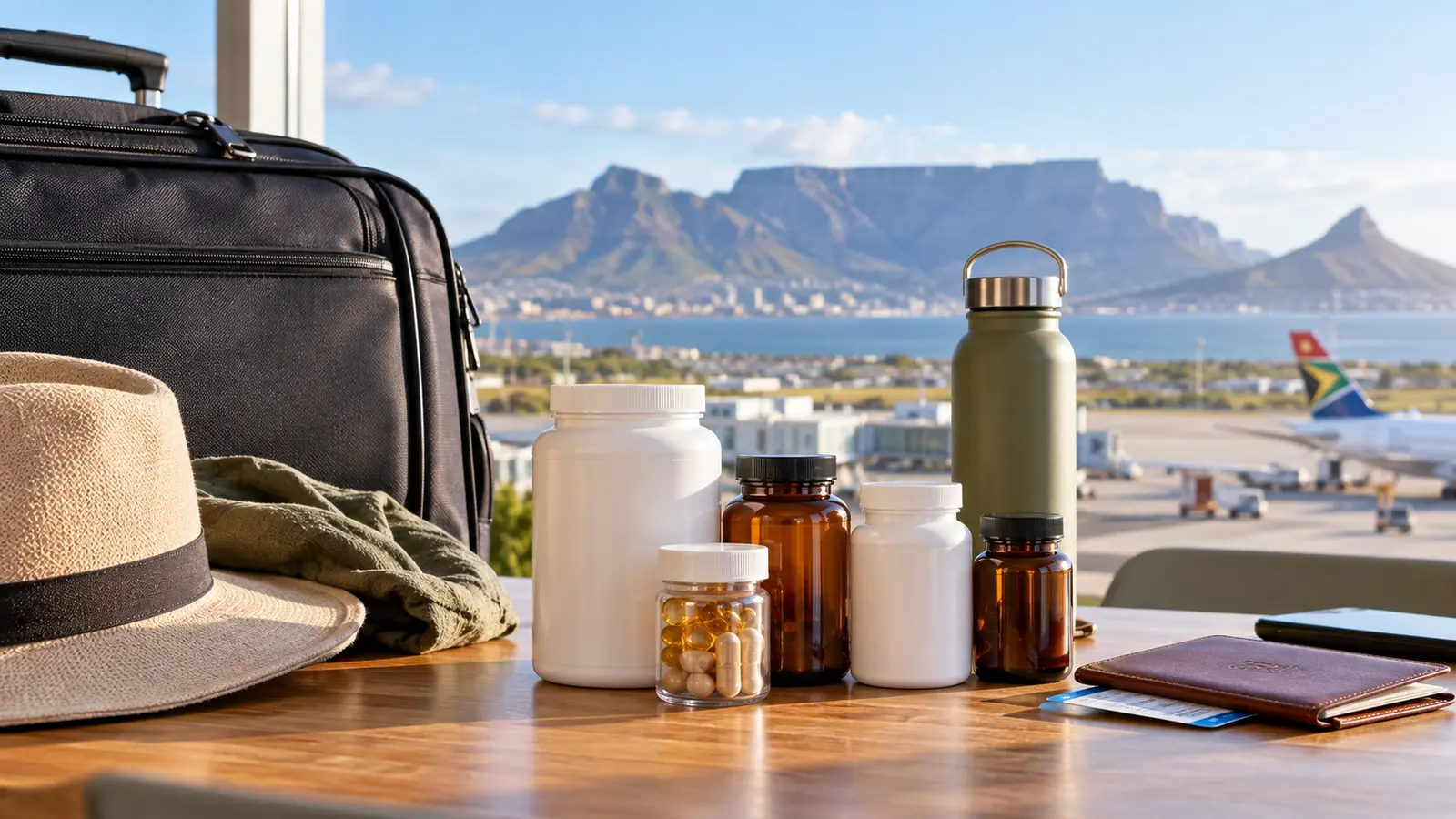
Travelling With Supplements in South Africa: Packing, Heat and Airport Checks
Holiday travel can disrupt even a simple wellness routine. Bottles are moved into smaller bags, powders lose their labels, tinctures sit in hot cars and people pack far more than they need because shops or couriers may be closed. A little planning protects both product quality and your peace of mind.
This guide focuses on practical travel within South Africa, with extra checks for international trips. It is not a guarantee that a product will be accepted at every border: airline, airport and destination-country rules can differ.
Start with a simple travel list
Write down every supplement, herbal product and medicine you plan to take. Include the brand, full ingredient list, strength, usual amount and the reason it is in your routine. This prevents forgotten items and makes it easier to answer questions at security or customs.
Separate the list into three groups:
- Prescribed medicines: these deserve the highest priority and may require a copy of the prescription or a clinician’s letter.
- Daily supplements: pack only what you are likely to use, plus a modest delay buffer.
- Optional products: leave behind anything you rarely use or have not yet tried.
Travel is not a good time to start several unfamiliar products. If a reaction occurs, you may be far from your usual healthcare support.
Keep products identifiable
Original packaging is usually the clearest option. It shows the product name, ingredients, batch details, directions and expiry date. Loose capsules in an unmarked bag can be difficult to identify and may attract unnecessary questions.
If space is limited, keep a clear photo of the front and back label and use a properly closed, labelled container. Do not mix different capsules into one bottle unless each item remains reliably identifiable.
Carry-on or checked luggage?
Keep essential items with you
Prescribed medicines and important daily products are generally better kept in hand luggage so that a delayed or missing suitcase does not leave you without them. Follow the airline’s rules for liquids, sharp objects and baggage size.
Protect against heat
Aircraft holds, parked vehicles and luggage areas can become very hot. Heat and moisture can damage capsules, gummies, oils and some liquid preparations. Never leave wellness products in a closed car in the South African sun.
For detailed storage guidance, read how to store supplements in South African heat and humidity.
How to pack different product types
Capsules and tablets
Close the lid securely and keep the desiccant sachet in the bottle if the manufacturer included one. Do not swallow the sachet. Avoid bathroom storage, wet toiletry bags and direct sun.
Powders
Keep powders in labelled, sealed containers. A scoop should be clean and dry. If you decant a small amount, record the exact product and serving information. Fine white powders are especially difficult to explain when unlabelled.
Tinctures and liquid extracts
Check hand-luggage liquid limits with your airline before departure. Tighten droppers, place each bottle in a sealed leak-resistant bag and cushion glass. Alcohol-containing tinctures may also be subject to destination rules.
Loose-leaf teas and botanicals
Keep the botanical name and ingredient label with the product. Plant materials that are ordinary in South Africa may be restricted elsewhere. Never assume that “natural” means unrestricted at an international border.
International travel needs an extra check
Before flying out of South Africa, check the official customs, health and agriculture information for the destination and any transit country. Rules can change and may distinguish between medicines, complementary products, food, dried plants and controlled ingredients.
For medically necessary treatment, ask the prescriber or pharmacist what documentation is appropriate. Carry enough time for this; do not rely on an airport official to resolve missing paperwork immediately.
Plan around delivery closures
Holiday newsletters often remind customers to order before courier or office closures. The useful lesson is not to panic-buy, but to count realistically. Check how many servings remain, allow for the delivery window and avoid buying quantities that will expire before use.
If a parcel may arrive after you leave, arrange a trusted recipient or delay the order. Heat-sensitive products should not sit in a delivery vehicle, locker or sunny doorway.
A pre-departure checklist
- Review medicines and supplements with a clinician or pharmacist when relevant.
- Check the expiry date, seal and storage instructions.
- Keep original labels or clear label photographs.
- Pack essential medicines in hand luggage.
- Use leak-resistant bags for liquids.
- Confirm airline and destination rules from official sources.
- Set phone reminders only if they help; adjust dosing times cautiously across time zones.
- Store everything away from children and pets at your destination.
Frequently asked questions
Can I take supplement capsules through a South African airport?
Ordinary supplements are commonly travelled with, but acceptance depends on the product, quantity, packaging, route and destination. Keep them clearly labelled and check official rules, particularly for international travel.
Can I put all my capsules into a pill organiser?
A pill organiser is convenient during the trip, but retain the original packaging or clear label details so the contents can be identified. Keep products separate if they look alike or have different directions.
Should I pack extra?
A small buffer for realistic delays can be sensible. Excessive quantities may create storage, expiry and border questions. Calculate from your itinerary rather than stocking up from anxiety.
What if a product became very hot in the car?
Do not assume it remains stable. Check the label, appearance, smell and manufacturer’s storage advice. When quality is uncertain, ask the supplier or pharmacist before using it.
Bottom line
Safe supplement travel is mostly good organisation: identifiable packaging, realistic quantities, temperature protection and official rule checks. Preserve prescribed care first and treat powders, tinctures and dried botanicals as products that may require additional explanation.
This article is for education only and is not medical or legal advice. Rules and individual health needs vary; check with your airline, destination authorities and qualified healthcare professional before travelling.