
Should You Take a Herbal Tincture Under the Tongue or in Water?
Written by Lize Bührmann, founder of Pharmatropia.
Many herbal tinctures can be swallowed directly or diluted in a small amount of water, but the label should decide. Holding drops under the tongue is not automatically necessary or superior. Mucosal absorption depends on the formulation and the plant compounds, while much of a typical tincture is swallowed and absorbed through the digestive tract either way.
What “under the tongue” actually changes
The tissue under the tongue is thin and well supplied with blood vessels. Medicines specifically formulated for sublingual use can enter circulation through this mucosa and partly avoid first-pass metabolism.
A conventional herbal tincture, however, is not automatically an engineered sublingual medicine. Plant extracts contain many compounds with different molecular size, solubility and permeability. Saliva also dilutes the liquid and carries much of it into the stomach. Claims that every tincture becomes dramatically more bioavailable under the tongue are too broad.
When direct use may suit
Direct administration can be practical when:
- the label specifically instructs oral or sublingual use;
- the small volume is easy to measure;
- the taste and alcohol concentration are comfortable;
- the mouth is healthy and unbroken;
- a practitioner has recommended that method for the exact preparation.
Do not let the dropper touch the tongue or lips. Contact can transfer saliva and microbes back into the bottle.
When water may be the better option
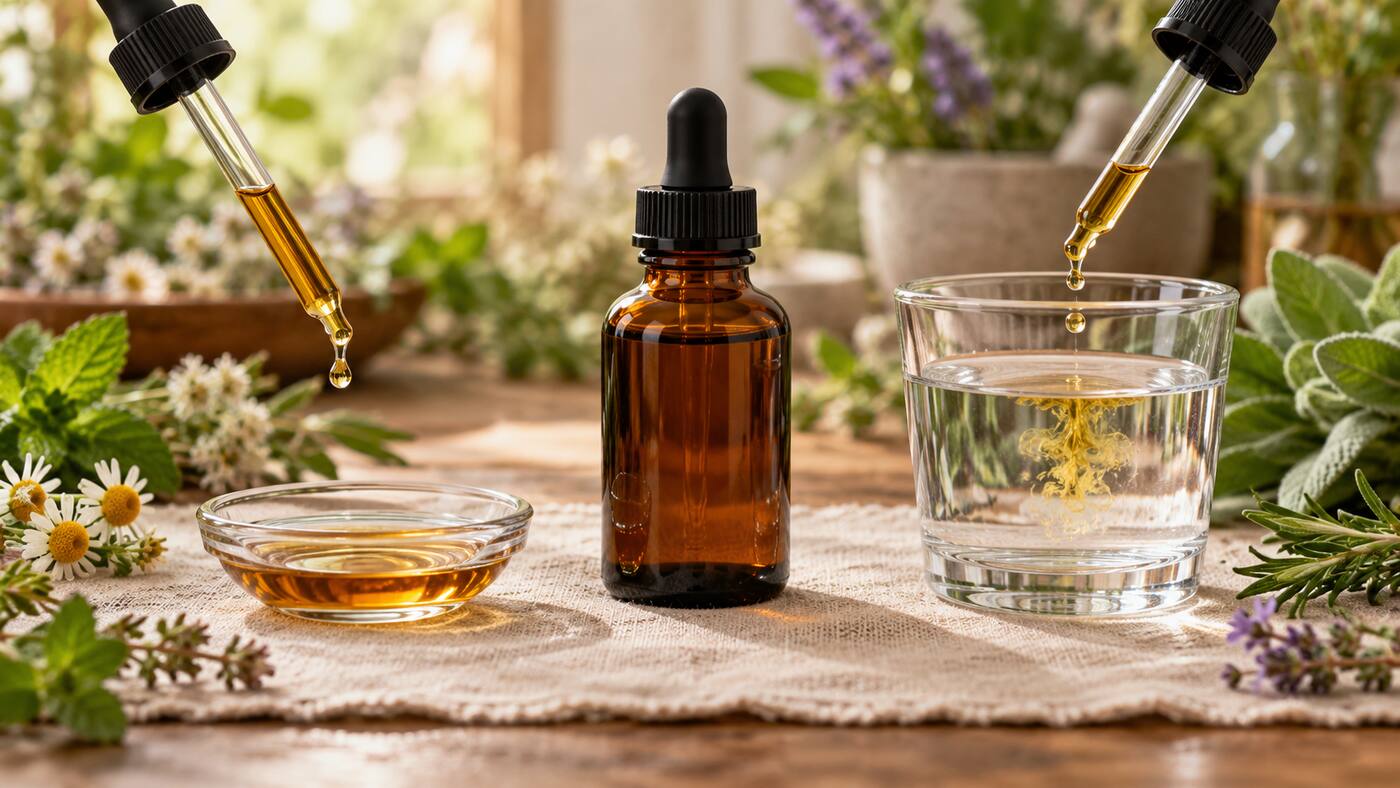
Diluting a measured dose in a small glass of water can reduce burning, bitterness and sensory intensity. It may suit people with a sensitive mouth, strong taste aversion or alcohol sensitivity. Water does not “deactivate” a normal oral tincture unless the product gives a specific warning.
Use a small volume if you want to ensure the full measured dose is consumed. Sip and rinse the glass with a little more water rather than leaving extract coating the sides.
Do not add every tincture to hot tea
Warm water may be acceptable for many products, but very hot liquid can evaporate alcohol and may affect volatile constituents. It also makes dose completion less predictable if the cup is not finished. Check the label rather than assuming heat is helpful.
If avoiding alcohol is essential, choose a correctly formulated alcohol-free product rather than trying to boil alcohol out at home. Our alcohol tincture versus glycerite guide compares the two formats.
Measurement matters more than the ritual
“One dropperful” is not a standard volume. Dropper bulbs, fill levels, liquid viscosity and angle all change the number of drops. Use the millilitre marking or supplied measuring device where possible.
See how many drops are in 1 ml and why millilitres are more reliable. Extraction ratios also differ, so 1 ml of one tincture is not equivalent to 1 ml of another.
Safety checks before either method
- Confirm the botanical species and plant part.
- Follow the labelled serving and maximum frequency.
- Review medicine interactions and pregnancy guidance.
- Avoid applying alcohol tinctures to mouth ulcers or irritated tissue.
- Never put essential oils under the tongue unless a qualified product is explicitly designed for that use.
- Keep the bottle away from children and pets.
For meal timing and stomach tolerance, read whether to take a tincture before or after food.
A simple decision guide
Use directly when the label permits it, you tolerate the taste and the preparation is intended for oral mucosal contact. Use in water when the label permits oral dilution and comfort or taste is the priority. Ask first when the tincture contains a high-risk plant, you take prescription medicine, are pregnant or breastfeeding, or the instructions are unclear.
Frequently asked questions
How long should I hold a tincture under my tongue?
There is no universal evidence-based time for all herbal tinctures. Follow the specific product directions rather than copying a fixed internet rule.
Does water make a tincture weaker?
It lowers the concentration in the mouth but does not reduce the measured amount consumed. Clinical effect depends on the product and constituent, not simply taste intensity.
Can I mix a tincture with juice?
Often, if the label allows it, but check interactions and finish the whole portion. Water is simpler and adds fewer variables.
Can I combine several tinctures in one glass?
Only after checking ingredients, total alcohol, overlapping effects and interactions. Combining products makes it harder to identify what caused a reaction.
Educational disclaimer: This article provides general administration guidance, not a dose recommendation for any specific herb.