
How Many Drops Are in 1 mL of Herbal Tincture?
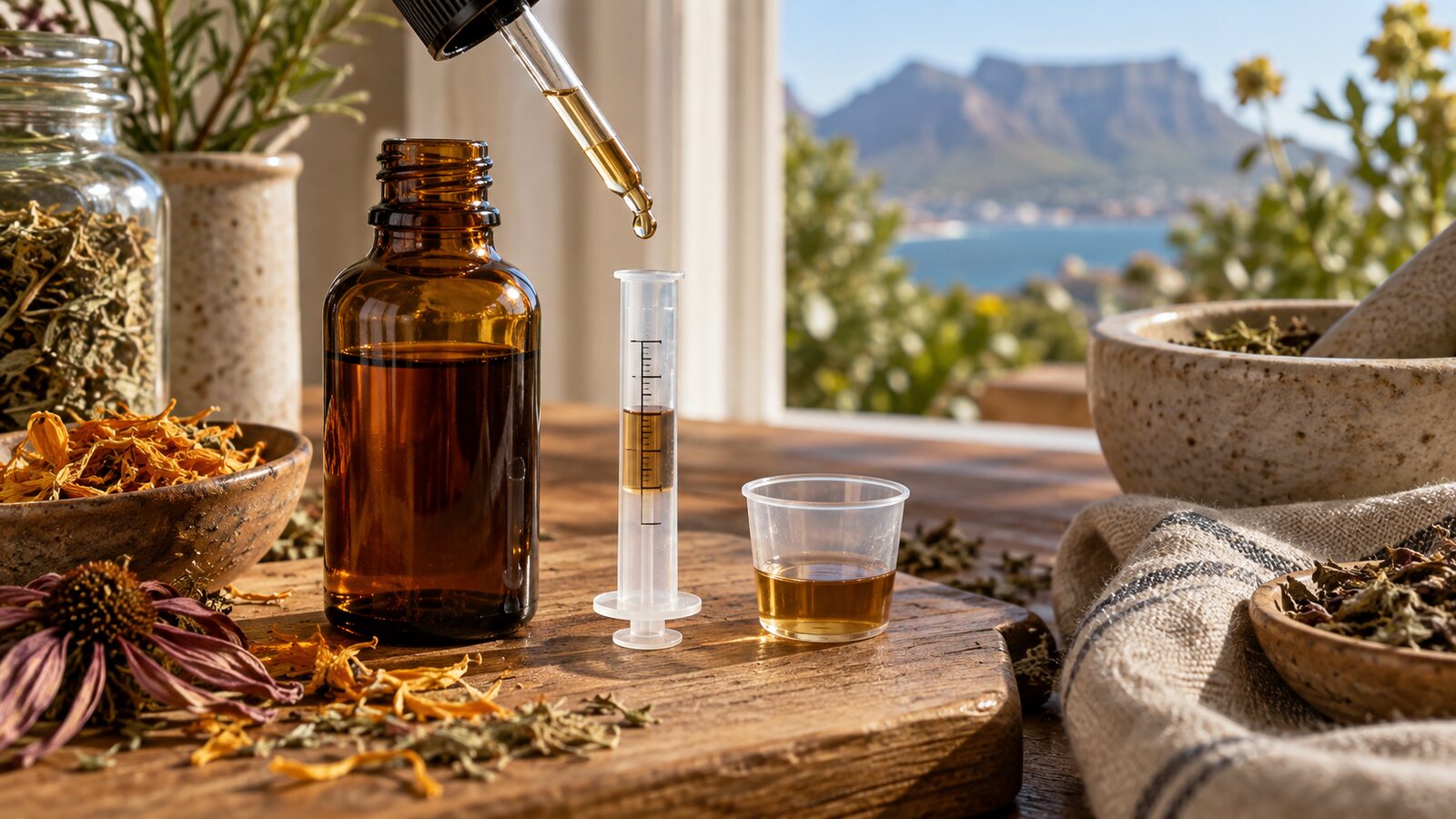
There is no universal number of herbal-tincture drops in 1 mL. “About 20 drops per millilitre” is a common rough convention for some droppers and thin liquids, but actual drop size changes with the dropper tip, liquid viscosity, surface tension, temperature and the angle at which the bottle is held.
If a label gives a dose in millilitres, the most reliable approach is to measure millilitres with the supplied calibrated device—not to convert it into an assumed number of drops.
Why is a drop not a fixed unit?
A drop forms when gravity overcomes the forces holding liquid to the tip. Change the tip diameter or liquid properties and the drop can change.
Factors include:
- the internal and external shape of the dropper tip;
- whether the liquid is alcohol-based, water-based, oily or glycerine-rich;
- the angle of the bottle or pipette;
- temperature and flow rate;
- residue around the dropper opening;
- how firmly a flexible bottle is squeezed.
Laboratory studies of dropper systems have found meaningful variation from formulation, tip design and dispensing angle. A study of plastic dropper tips, for example, showed that drop weight changed with solution properties and angle. The research examined ophthalmic droppers rather than herbal tinctures, but it illustrates the physical reason that “one drop” is not universally precise.
What does “one full dropper” mean?
It is often ambiguous. The glass pipette may not fill to the top when the rubber bulb is squeezed once. Some pipettes are marked in millilitres; others are not. “One dropperful” should therefore be defined by the manufacturer rather than guessed from the bottle size.
A 30 mL bottle does not mean the pipette holds 1 mL. Bottle capacity and pipette capacity are separate measurements.
Drops, millilitres and extract ratios answer different questions
Drops and millilitres describe volume. A ratio such as 1:2 or 1:5 describes how plant material and extraction liquid were related during manufacture. Milligrams may describe a dried extract or a named constituent. These values cannot be swapped without product-specific information.
For an explanation of manufacturing ratios, see What Does 1:2, 1:5 or 1:10 Mean on a Herbal Tincture?
When should you use an oral syringe?
If the label specifies a dose in millilitres and accuracy matters, a correctly sized oral syringe is often easier to read than a cup or unmarked pipette. In a consumer study comparing liquid-measuring devices, participants measured a 5 mL dose more accurately with an oral syringe than with a dosing cup.
Choose a syringe whose scale suits the volume. A 1 mL syringe is easier to read for a small volume than a large 10 mL syringe. Never use an injection needle; an oral syringe is a needle-free measuring device.
How to measure a tincture more consistently
- Read the unit on the label: drops, mL or another measure.
- Use the device supplied or recommended for that exact product.
- Hold a dropper in the position specified by the manufacturer, usually vertical.
- Keep the tip clean and do not touch it to the mouth.
- Read a syringe at eye level and use the correct edge of the plunger.
- Do not use a kitchen teaspoon for a precise volume.
- Ask the supplier if the instructions use the vague term “dropperful”.
Can you calculate how long a bottle will last?
Yes, if the labelled daily amount is in millilitres. Divide the usable bottle volume by the daily volume. A 30 mL bottle used at 1 mL daily contains approximately 30 daily volumes. This calculation does not account for spillage or liquid left in the bottle.
If the instructions use drops, calculate only with the manufacturer’s stated or validated drop count for that product. Do not assume every 30 mL tincture contains exactly 600 drops.
Why accurate measuring matters
Botanical extracts vary widely in strength and pharmacology. A few-drop difference may be unimportant for one low-concentration preparation but meaningful for another. Accuracy is especially important for children, older adults, concentrated preparations and products with interaction potential.
Never scale a dose from another brand based only on the shared plant name. Different ratios, solvents, extracts and serving instructions can produce very different preparations. Our South African herbal tincture buyer’s guide covers the label details worth comparing.
Frequently asked questions
Is 20 drops always 1 mL?
No. It is only a rough convention for some droppers and liquids. Use a calibrated device when the label specifies millilitres.
How much does a glass dropper hold?
It varies. Check for printed graduations or confirm the capacity with the supplier.
Can I use a kitchen teaspoon?
Not for a precise dose. Household teaspoons vary. Use a supplied measuring device or oral syringe.
Should I count drops into water?
Only if the label instructs you to. Adding a measured tincture dose to water can make the taste easier, but the dose should be established before dilution.
Does a larger drop mean a stronger tincture?
No. Drop size is a volume issue; strength depends on the preparation and concentration.
Educational information only. Follow the specific product label and seek professional advice for concentrated extracts, medicines, pregnancy, breastfeeding or use in children.
Written by Lize Bührmann, founder of Pharmatropia.