
The Colour Red in Wellness Rituals: Grounded Courage, Not Constant Urgency
Red is difficult to ignore. It can suggest warmth, vitality, danger, love, anger, ceremony or belonging, depending on culture and personal experience. A red colour wellness ritual can use that visual intensity as a prompt for grounded action—without claiming that colour itself treats a health condition.
The useful question is not “What does red do to everyone?” but “What does red help me notice, choose or practise today?”
Why red often feels active
Red is visually prominent and is widely used to signal importance. Context changes the response: a red flower may feel celebratory, while a red warning light asks for caution. Individual memory, sensory sensitivity and cultural meaning matter as much as colour theory.
Research on colour and emotion is interesting but highly context-dependent. Room lighting, saturation, brightness, expectation and the task being performed can all influence results. Red should therefore be treated as a reflective cue, not a universal nervous-system prescription.
Four grounded themes for a red ritual
Courage
Courage is not the absence of fear. It can be one small action taken while fear is present: making a call, asking a clear question or beginning a task for ten minutes.
Boundaries
Red can represent a stop line. Use it to identify one limit that protects your time, energy or safety. A boundary works best when it is specific and communicated respectfully.
Embodiment
Choose an ordinary physical anchor—feet on the floor, a slower exhale, a warm cup held in both hands or a short walk. The aim is to return attention to the present, not to force a particular feeling.
Deliberate action
High energy without direction can become urgency. Write down one meaningful action, the first step and the time you will do it. Leave the rest for later.
A simple ten-minute red-colour ritual
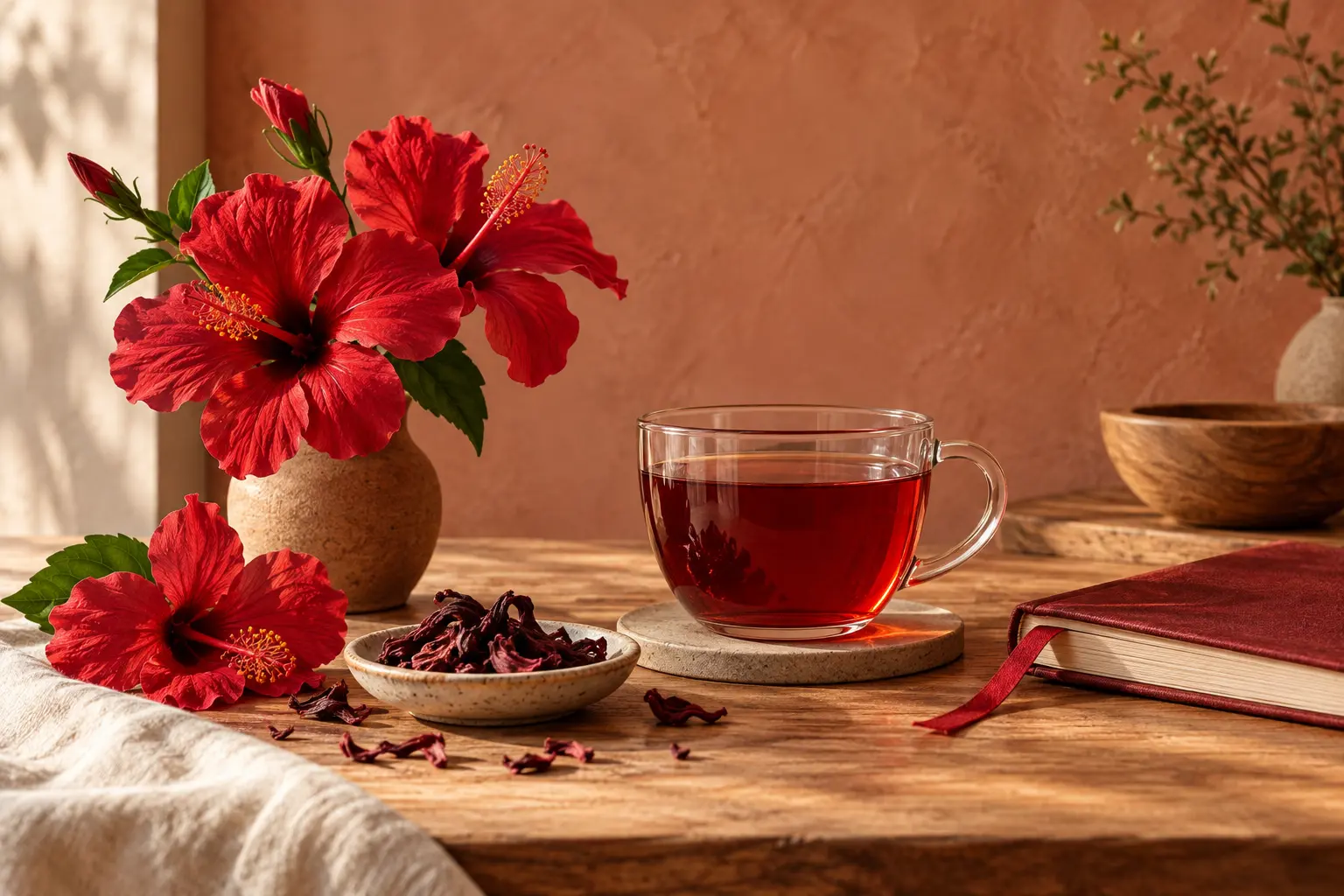
- Place one red object nearby: a flower, cloth, journal ribbon or piece of fruit.
- Notice what the colour evokes without deciding that the response is right or wrong.
- Take three comfortable breaths; do not force deep breathing if it makes you light-headed.
- Write one sentence beginning, “The action that matters most now is…”
- Choose a step that can be completed in ten minutes.
- Finish by checking whether you feel steadier, overstimulated or unchanged.
Colour does not make unlike products equivalent
A ruby herbal tea, a botanical resin and a red smudge bundle may look related in a collection, but they have different ingredients, routes of use and safety considerations. Colour is not a reason to combine or substitute products.
Hibiscus is commonly prepared as a tart infusion. It may not suit everyone, particularly when medicines or blood-pressure concerns are involved. Dragon’s blood resin has a long traditional history, but preparation and intended route matter. Read our evidence-aware guide to dragon’s blood resin, traditional use and safety before assuming that topical, aromatic and internal uses are interchangeable.
When red may be the wrong cue
If red feels agitating, threatening or simply unpleasant, choose another colour. A ritual should support agency. People with migraine, sensory sensitivity or trauma-related responses may prefer muted shades, natural textures or no colour cue at all.
Frequently asked questions
Does red increase energy?
It can feel energising in some settings, but responses vary. Red is not a treatment for fatigue, depression, anaemia or any other medical cause of low energy.
Can a red ritual reduce anxiety?
A structured pause may help some people organise attention, but colour alone does not treat anxiety. Persistent or severe symptoms deserve qualified support.
Do I need a red wellness product?
No. An ordinary object is enough. The value lies in the reflection and action, not in buying something.
Can I use candles?
Only if open flames are safe in your environment. A flower, notebook or cloth works just as well.
Educational information only. Colour practices are reflective wellbeing tools, not medical or psychological treatment. Seek appropriate professional care for persistent symptoms, sudden changes or safety concerns.
Written by Lize Bührmann, Doctor of Natural Medicine and founder of Pharmatropia.