Dragon’s Blood Resin: Traditional Uses, Evidence and Safety
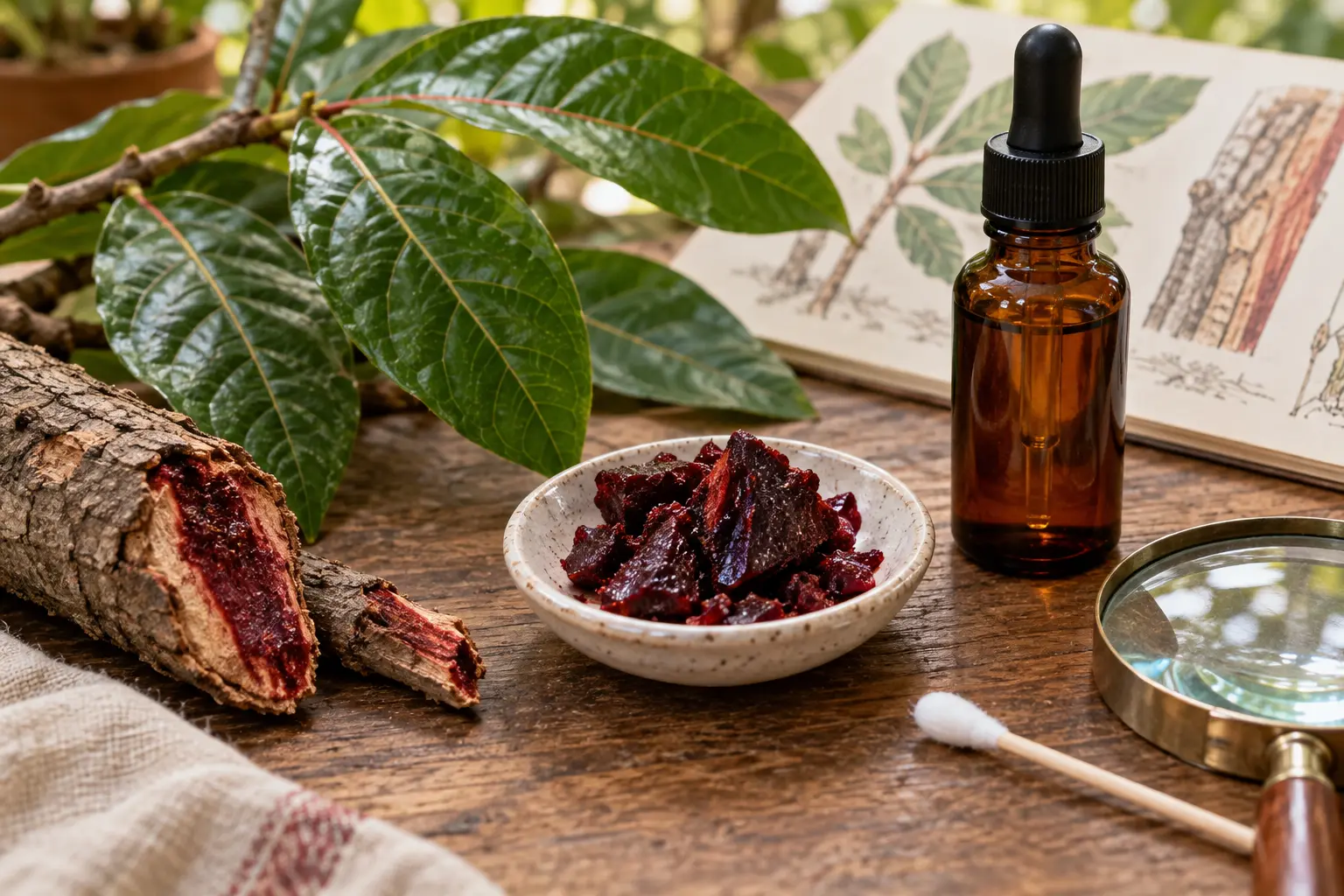
Dragon’s Blood is the dramatic common name given to deep red resins or latexes from several unrelated plants. In Amazonian herbal traditions, the name often refers to the latex of Croton lechleri, also known as sangre de grado. Correct botanical identity matters because products sold under the same common name may come from different species and are not interchangeable.
Traditional context
Croton lechleri grows in parts of South America and has a long history of traditional topical and internal use. Recorded applications include skin care and digestive complaints. This history is meaningful, but it does not establish that every bottled resin is safe, correctly identified or proven to treat a medical condition.
Responsible discussion should recognise both the knowledge tradition and the difference between traditional practice, laboratory investigation and modern clinical evidence.
What has research examined?
Researchers have studied tannins, proanthocyanidins and other constituents in Croton lechleri latex. A purified compound derived from the plant led to a specific prescription medicine for certain forms of diarrhoea. That medicine is standardised and clinically regulated; it is not equivalent to taking an unstandardised resin or tincture.
Laboratory findings relating to microbes, inflammation or tissue processes should not be converted into promises that a retail resin cures infection, ulcers, reflux, food poisoning or wounds.
Check the exact product
- Look for the full botanical name, ideally Croton lechleri.
- Confirm whether it is raw latex, resin, tincture, cosmetic or incense.
- Read the ingredient list for alcohol, fragrance and other additives.
- Check the batch, expiry date, storage instructions and responsible supplier.
- Do not assume an incense product is suitable for skin or internal use.
Topical use needs care
A resin can stain skin, fabric and surfaces. Apply only according to the specific product directions, avoid the eyes and mucous membranes, and consider a small patch test on intact skin. Stop if burning, swelling, blistering or a spreading rash develops.
Deep wounds, animal or human bites, burns, infected injuries and wounds that will not close need appropriate medical assessment. A resin should not seal contamination into a wound or replace cleaning, tetanus guidance, stitches or antibiotics when these are clinically necessary.
See our natural first-aid kit guide for clearer boundaries between home care and professional care.
Internal use is not a casual extension of topical use
Do not swallow a product unless it is explicitly made and labelled for that route and an appropriately qualified professional has reviewed its suitability. Pregnancy, breastfeeding, childhood, liver or kidney disease and regular medicine use require additional caution.
Persistent abdominal pain, vomiting blood, black stool, dehydration, fever or severe diarrhoea needs medical attention rather than repeated self-treatment.
Sustainability and cultural respect
Ask whether harvesting is traceable and whether the supplier supports responsible collection. Bark damage and excessive tapping can harm trees. Common names and dramatic marketing should not erase the communities that developed traditional knowledge around the plant.
Frequently asked questions
Is Dragon’s Blood the same as dragon’s blood incense?
Not always. Incense resins may come from other genera such as Daemonorops or Dracaena. Check the botanical source and intended use.
Does the dark red colour prove quality?
No. Colour alone cannot confirm species, purity, freshness or concentration.
Can it treat an ulcer?
A retail resin should not be presented as a proven ulcer treatment. Ulcer-like pain can have serious causes and warrants clinical assessment.
Written by Lize Bührmann, founder of Pharmatropia. This article is for general education and does not provide a diagnosis, dosing plan or substitute for medical care.