Gelatin vs Vegetable Capsules: Which Is Better?
Written by Lize Bührmann, founder of Pharmatropia.
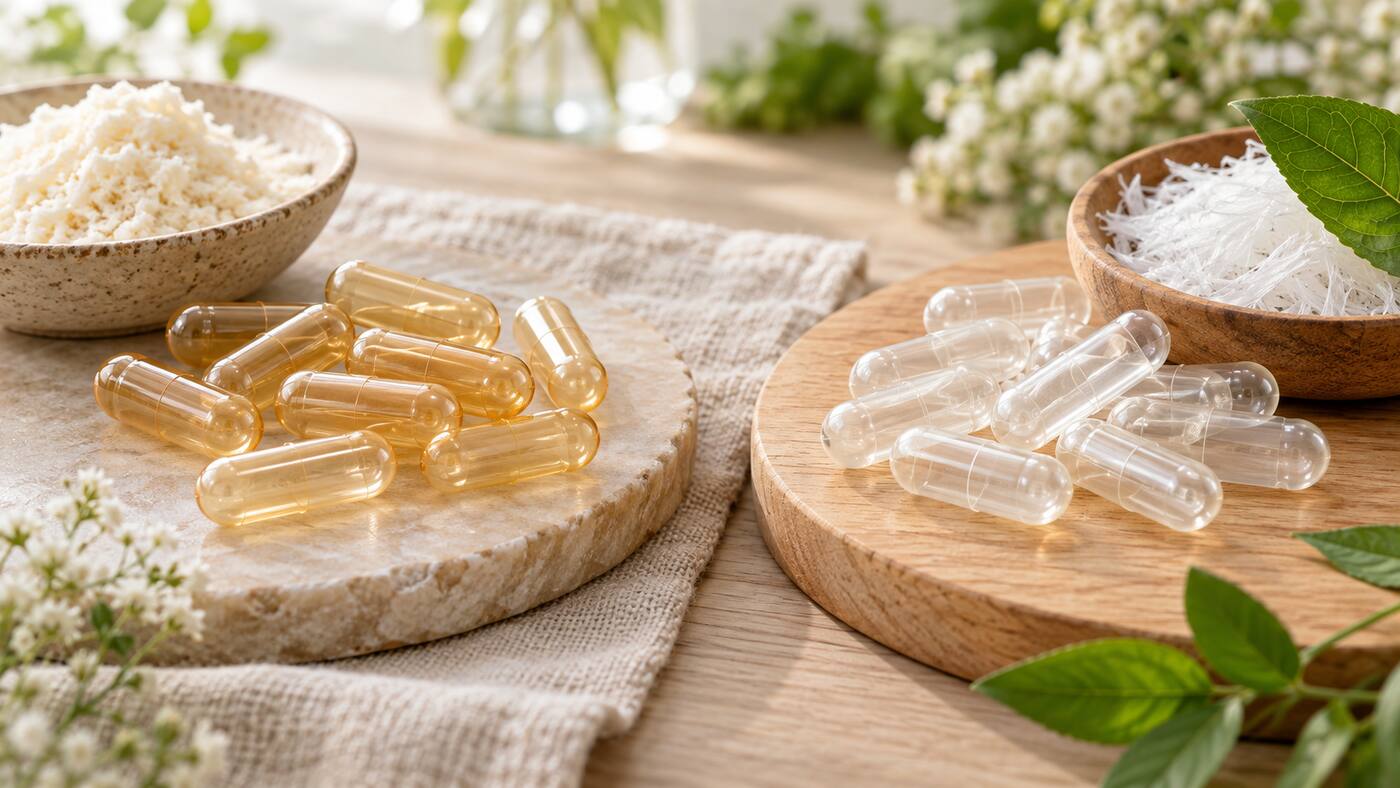
Neither gelatin nor vegetable capsules are universally better. Gelatin has a long manufacturing history and is often economical; vegetable capsules suit people avoiding animal-derived ingredients and may behave differently around moisture. For most shoppers, the decisive questions are dietary suitability, certification, the quality of the finished product and what is inside the shell.
What are gelatin capsules made from?
Gelatin is a protein produced from animal collagen. Hard capsule shells are commonly bovine or porcine in origin, although fish gelatin also exists. “Gelatin” alone does not tell you the animal source, welfare standard or whether the batch is halal or kosher.
If those details matter, look for a species declaration and current certification. Bovine does not automatically mean halal, and a clear capsule is not automatically plant based.
What are vegetable capsules made from?
Most vegetable capsules use hydroxypropyl methylcellulose (HPMC), a cellulose-derived polymer. Another option is pullulan, a polysaccharide produced by fermentation. A shell described as vegetarian refers only to the shell; the fill, colourants, flow agents and processing aids must also meet the relevant standard before the entire product can be called vegan.
Our guide to excipients and fillers in supplements explains why the complete ingredient list matters.
Do they dissolve differently?
Both types are designed to disintegrate and release their contents in the digestive tract. Laboratory comparisons have found differences in dissolution time under particular test conditions, but that does not make one shell superior in every finished supplement. The fill material, capsule grade, storage, age, humidity and test medium can all affect performance.
Gelatin may cross-link in some formulations or storage conditions, slowing dissolution. HPMC performance can vary with the specific manufacturing system and gelling agents. A reputable manufacturer validates the complete product, not only the empty shell.
Moisture and South African storage conditions
Gelatin naturally holds more water and can become brittle in very dry conditions or soften in high humidity. HPMC generally contains less moisture and may suit hygroscopic powders or wider humidity ranges. Neither should be left in a hot vehicle, steamy bathroom or sunny kitchen.
Keep supplements tightly closed, away from heat and moisture, with the supplied desiccant left in place unless the label says otherwise. A shell that feels unusually sticky, cracked or distorted may indicate poor storage.
Dietary, religious and allergy considerations
- Vegetarian or vegan: choose a verified HPMC or pullulan shell and confirm the fill ingredients.
- Halal: look for recognised certification on the finished product; do not infer it from “bovine”.
- Kosher: similarly, rely on product-specific certification.
- Animal-protein sensitivity: discuss the source with the manufacturer and a clinician.
- Cellulose sensitivity: HPMC is widely used, but individual excipient tolerances still matter.
Does the shell change absorption?
Once a suitable capsule disintegrates, absorption is driven mainly by the ingredient’s chemistry, dose, formulation and the person taking it. Marketing claims that one shell automatically provides dramatically better absorption need product-specific evidence.
For a botanical extract, ask about species, plant part, extraction ratio and standardisation. For a mineral, check the compound and elemental amount. The multi-ingredient supplement label checklist shows how to assess the whole formula.
A practical buying checklist
- Read the exact shell material, not only “capsule”.
- Confirm animal species or HPMC/pullulan.
- Check independent halal, kosher or vegan certification if required.
- Review all fill ingredients and excipients.
- Check batch number, expiry date and storage instructions.
- Prefer measured quality information over “clean” or “premium” language.
Frequently asked questions
Are vegetable capsules safer?
Not inherently. Both materials can be appropriate when correctly manufactured. Safety depends on the full product, dose, contaminants, interactions and suitability for the user.
Are gelatin capsules always pork based?
No. They may be bovine, porcine, fish or another permitted source. Ask when the label does not specify.
Do vegetable capsules contain plastic?
HPMC is a modified cellulose polymer used to form capsule films. Calling it simply “plastic” is misleading, but people wanting the least processed option should still read the specification.
Can I open either type of capsule?
Only if the product directions allow it. Do not open modified-release, delayed-release or irritating formulations without professional advice.
Educational disclaimer: This article explains capsule materials and is not a guarantee about any specific finished product.