Essential Oil vs Botanical Absolute: What’s the Difference?
Written by Lize Bührmann, founder of Pharmatropia.
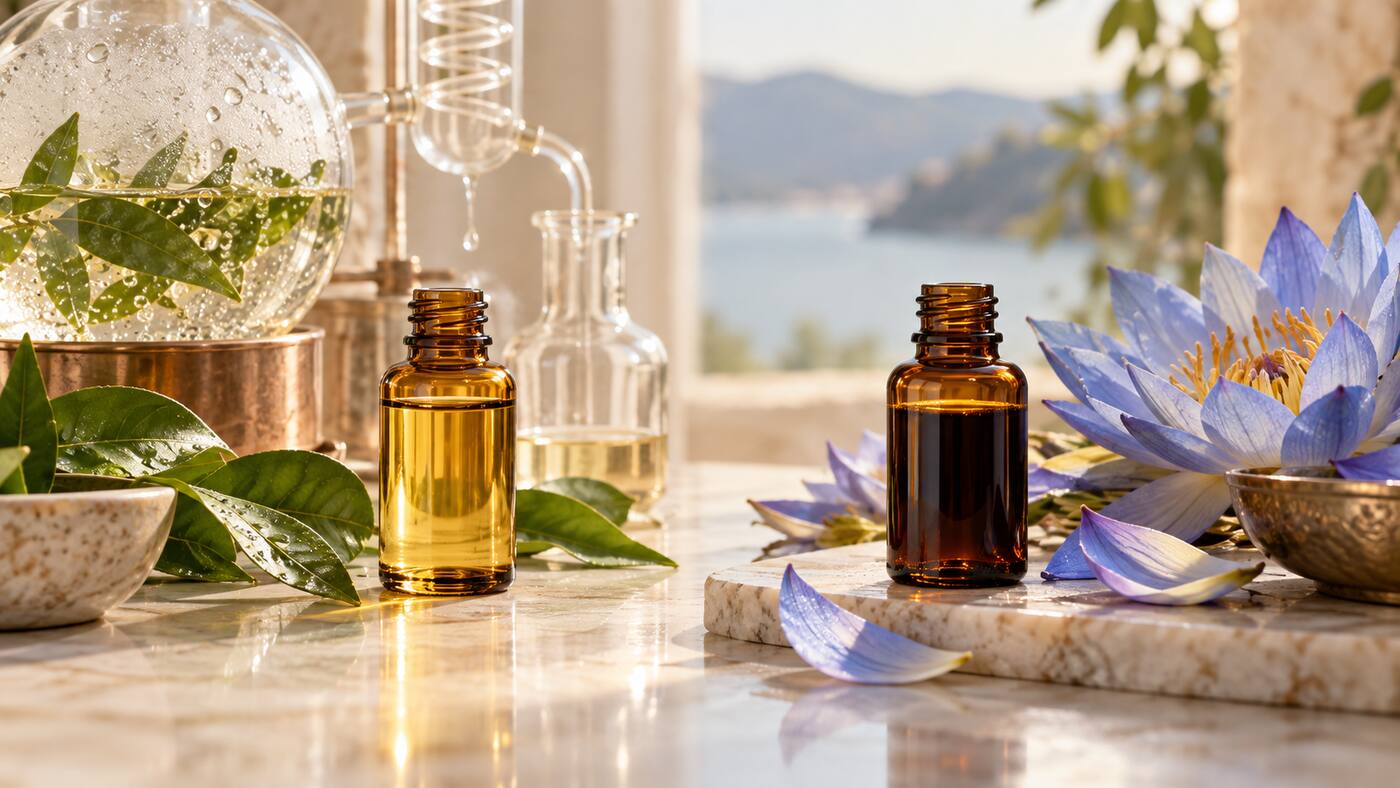
An essential oil and a botanical absolute are two different aromatic extracts. Essential oils are generally produced by steam or water distillation, dry distillation, or mechanical expression of citrus peel. Absolutes are usually made by solvent extraction followed by ethanol washing and removal of waxes. The method changes the aroma, colour, viscosity, composition and appropriate use.
Neither is automatically “better”, safer or more therapeutic. The correct choice depends on the plant, formulation and intended aromatic or cosmetic application.
What is an essential oil?
The international vocabulary standard ISO 9235:2021 defines an essential oil by the physical processes used to obtain it from plant material. Steam distillation is common for leaves, woods, roots and flowers; citrus peel oils are often mechanically expressed.
Distillation collects volatile compounds that travel with steam and are separated from the water after condensation. Heat and water can change which compounds appear in the final aroma. The result may smell cleaner, brighter or different from the living plant.
What is a botanical absolute?
Delicate flowers may yield little usable aromatic material through steam distillation. Solvent extraction can capture a broader set of fragrance molecules together with waxes and pigments. The first waxy extract is often called a concrete. Washing the concrete with ethanol, cooling and filtering out waxes, then removing the ethanol produces an absolute.
Absolutes are frequently darker, thicker and more intense than distilled oils. Jasmine, tuberose and some lotus materials are commonly sold as absolutes because their fragrance is difficult to capture by conventional distillation.
Essential oil versus absolute at a glance
| Feature | Essential oil | Botanical absolute |
|---|---|---|
| Main process | Distillation or citrus-peel expression | Solvent extraction followed by ethanol washing |
| Aroma | Often lighter or more volatile | Often fuller and closer to the fresh flower |
| Texture | Usually fluid | Can be viscous, dark or semi-solid |
| Quality questions | Botanical identity, distillation, oxidation and adulteration | Botanical identity, solvent process, residues and dilution |
| Typical use | Aromatherapy and fragranced formulations | Perfumery and highly concentrated aromatic formulations |
Is an absolute “more natural”?
Both begin with botanical material, but “natural” does not describe the complete manufacturing history or guarantee safety. An absolute involves processing solvents; a distilled essential oil involves heat and water. A well-made extract should have transparent specifications appropriate to its intended use.
Ask for the botanical name, plant part, extraction method, country of origin, batch details and whether the product is neat or diluted. For an absolute, meaningful residual-solvent testing may be relevant. A generic certificate that does not match the batch is not enough.
What does “absolute oil roller” mean?
A roller product usually contains a small amount of absolute diluted in a carrier oil so it can be applied more conveniently. It is not the same as a bottle of neat absolute. The label should identify the carrier and concentration or provide safe-use directions.
Pharmatropia’s Blue Lotus Absolute Oil Roller is a finished roller format. Its directions should be followed as supplied; do not assume directions for a neat perfumery material apply to a pre-diluted product.
Can either product be swallowed?
Do not assume so. Aromatic extracts are concentrated and may be harmful if ingested. A fragrance, cosmetic or aromatherapy label is not an instruction for internal use. Keep both away from children and pets, and contact a poison-information service if a significant amount is swallowed.
For skin use, dilution, patch testing and sun-sensitivity warnings may apply. Oxidised oils can become more irritating, so close the bottle and store it away from heat and direct light.
Is an absolute the same as a flower essence?
No. An absolute contains concentrated aromatic molecules extracted from flowers. A flower essence is a water-based complementary preparation associated with symbolic or emotional practice and usually has little or no aromatic oil. Read flower essences versus essential oils for the full distinction.
What about “Blue Lotus essential oil”?
Product names in the marketplace are not always technically precise. A bottle sold as Blue Lotus “essential oil” may actually be an absolute, fragrance blend, infused carrier oil or diluted aromatic extract. Check the ingredient list and extraction method rather than relying on the front label.
For the botanical and traditional context, see our grounded guide to Blue Lotus history and modern safety.
A responsible buying checklist
- Confirm the Latin botanical name and plant part.
- Ask whether it is distilled, expressed, solvent-extracted or infused.
- Check whether it is neat or diluted and identify the carrier.
- Look for batch traceability and appropriate quality documentation.
- Follow the stated route of use; do not improvise ingestion.
- Avoid cure claims and unsupported “therapeutic grade” language.
Frequently asked questions
Is an absolute stronger than an essential oil?
It may smell richer or be more concentrated in a formulation, but “stronger” is not a standard safety or efficacy measure. Composition and intended dilution matter.
Do absolutes contain solvent?
The manufacturing solvents are removed during processing, but trace residues can be a quality consideration. Reputable suppliers should control them to relevant specifications.
Can I use an absolute in a diffuser?
Only if the finished product and diffuser instructions allow it. Thick materials may not disperse properly and can damage some devices.
Which is better for aromatherapy?
Most conventional aromatherapy literature concerns essential oils. Absolutes are widely used in perfumery and aromatic rituals, but evidence for health outcomes is limited. Choose for scent and safe formulation, not disease-treatment promises.
Educational note: This article is general product education. Concentrated aromatic extracts can irritate skin or be toxic if misused; follow the exact product directions.