
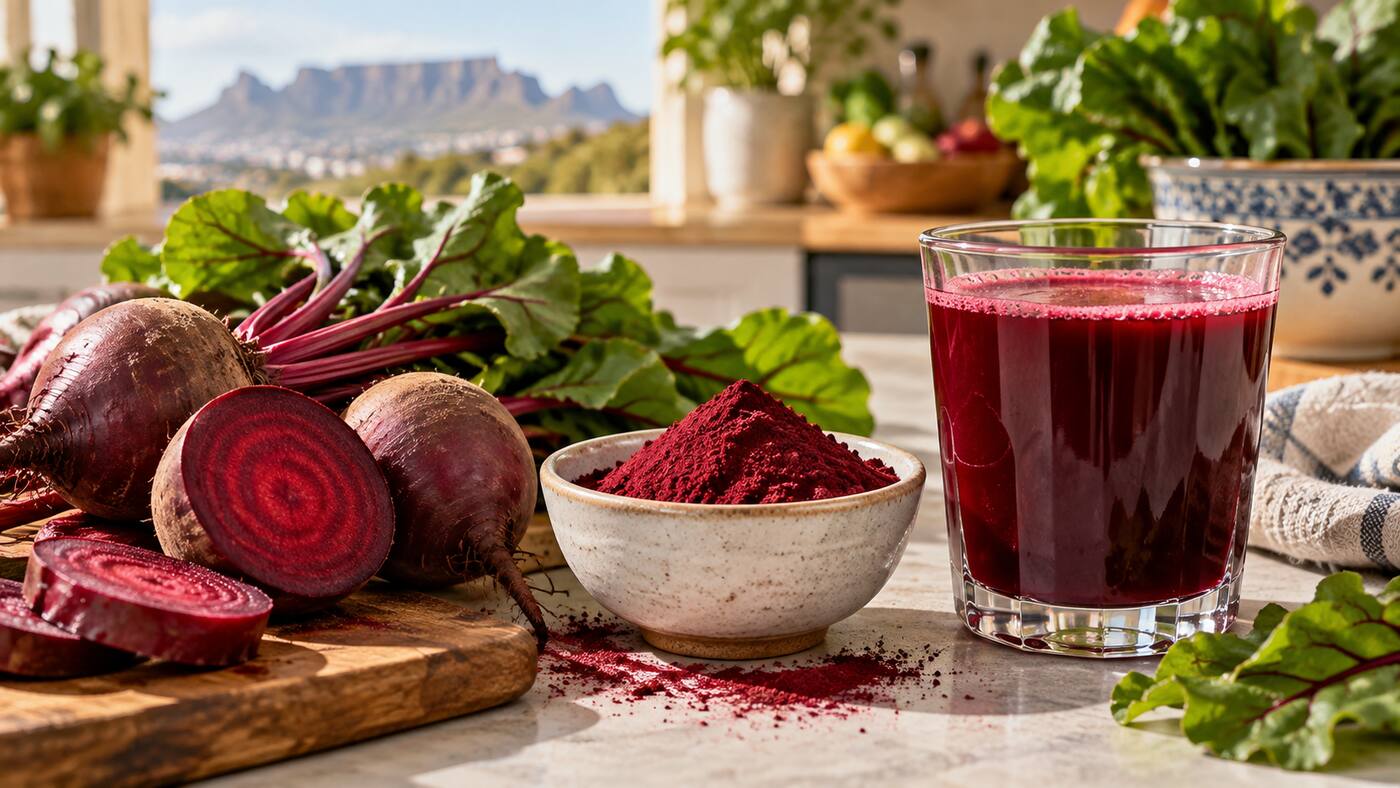
Beetroot Powder vs Beetroot Juice for Nitric Oxide
Written by Lize Bührmann, founder of Pharmatropia.
For nitric-oxide support, the better beetroot product is the one that declares a meaningful, consistent nitrate amount—not automatically the juice or the powder. Beetroot juice is the format used in much of the human research, especially standardised concentrated shots. Powder is portable and may retain more whole-food material, but nitrate can vary widely with the beet crop and processing.
A bright red colour, a large scoop or the words “beet superfood” do not tell you how much nitrate the serving contains.
How beetroot supports the nitrate pathway
Dietary nitrate is absorbed and recirculated into saliva. Nitrate-reducing bacteria in the mouth convert some of it to nitrite, which can then contribute to nitric-oxide formation in the body. Nitric oxide is involved in vascular signalling and blood-vessel tone.
This is different from the L-citrulline pathway. Our article on beetroot versus L-citrulline explains why two products labelled “nitric oxide support” may work through different routes.
Beetroot juice: strengths and limitations
Concentrated beetroot juice has several practical advantages:
- it is the format used in many exercise and vascular studies;
- some products standardise or declare nitrate per serving;
- a measured shot can be convenient before exercise; and
- liquid requires no mixing.
But juice can contain natural sugars, needs refrigeration after opening, may be bulky, and can stain. Most importantly, ordinary beetroot juice is not automatically standardised. Two red bottles can contain very different nitrate amounts.
A 2024 scientific review found hints that whole beetroot juice may sometimes have effects beyond an equivalent nitrate salt, possibly because of other phytonutrients, but direct comparisons were few and inconsistent. The authors concluded that firm claims cannot yet be made. See the review indexed in PubMed.
Beetroot powder: strengths and limitations
Powder is light, shelf-stable and easy to add to water or food. Depending on manufacture, it may retain fibre and other beet components. It can suit someone who dislikes a concentrated juice shot.
The weakness is predictability. Drying conditions, plant variety, storage and serving size can affect nitrate. A powder label may show grams of beetroot without stating nitrate in milligrams or millimoles. Grams of powder and milligrams of nitrate are not interchangeable.
Comparison at a glance
| Question | Beetroot juice | Beetroot powder |
|---|---|---|
| Research base | Widely used in nitrate studies | Growing but less consistent across products |
| Portability | Lower, especially after opening | High |
| Nitrate certainty | Good only when declared or standardised | Good only when declared or standardised |
| Food matrix | Liquid, usually little fibre | May retain more solids or fibre |
| Main buying check | Nitrate per serving and storage | Nitrate per serving, processing and scoop size |
What should the label tell you?
For a product marketed specifically for nitric-oxide support, look for:
- nitrate per serving, stated in milligrams or millimoles;
- a clear serving size;
- batch or lot identification;
- storage instructions and expiry date;
- all added ingredients, including sugar, flavours or stimulants; and
- a responsible manufacturer or importer.
A certificate of analysis is useful only if it matches the product and batch and includes a relevant test. Generic “lab tested” language does not prove nitrate content.
Does more nitrate mean a better product?
Not automatically. More is not always appropriate, and individual response varies. Research outcomes differ by age, fitness, diet, oral bacteria and health status. A recent randomised trial in 15 older adults with treated hypertension increased nitrate exposure and nitrate metabolites but did not find sustained improvements in home or 24-hour blood pressure. That is a useful reminder not to promise a universal outcome.
Safety and medicine considerations
Beetroot can turn urine or stool pink-red, which is usually benign but can be alarming. It may also cause digestive discomfort. People prone to oxalate kidney stones, those with kidney disease and anyone restricting potassium should ask for individual advice.
Because nitrate-rich products may affect vascular tone, combine them cautiously with blood-pressure medicines, prescription nitrates or other circulation products. Read nitric-oxide supplements and blood-pressure medicine.
Strong antibacterial mouthwash may temporarily reduce oral nitrate conversion. Our evidence-led guide explains the relationship between mouthwash, beetroot and nitric oxide.
Frequently asked questions
Is beetroot powder as effective as beetroot juice?
It can deliver nitrate, but effectiveness cannot be predicted from format alone. Compare the declared nitrate dose and evidence for that exact product.
Is beetroot juice better before exercise?
Juice is better studied in exercise contexts, but responses vary and it does not replace training, hydration or appropriate nutrition. Product directions and professional advice should guide timing.
Does beetroot powder have less sugar?
A small powder serving may contain less total sugar than a glass of juice, but labels and portion sizes differ. Compare nutrition panels rather than assuming.
Can I use fresh beetroot instead?
Fresh beetroot is a nutritious food and contributes dietary nitrate, fibre and micronutrients. Its nitrate amount is naturally variable, so it is less suited to a precisely standardised protocol.
Educational note: This article is general information. Beetroot products are not a substitute for prescribed cardiovascular treatment or individual medical advice.
For exercise timing and product-label considerations, see how long beetroot powder may take to work.