
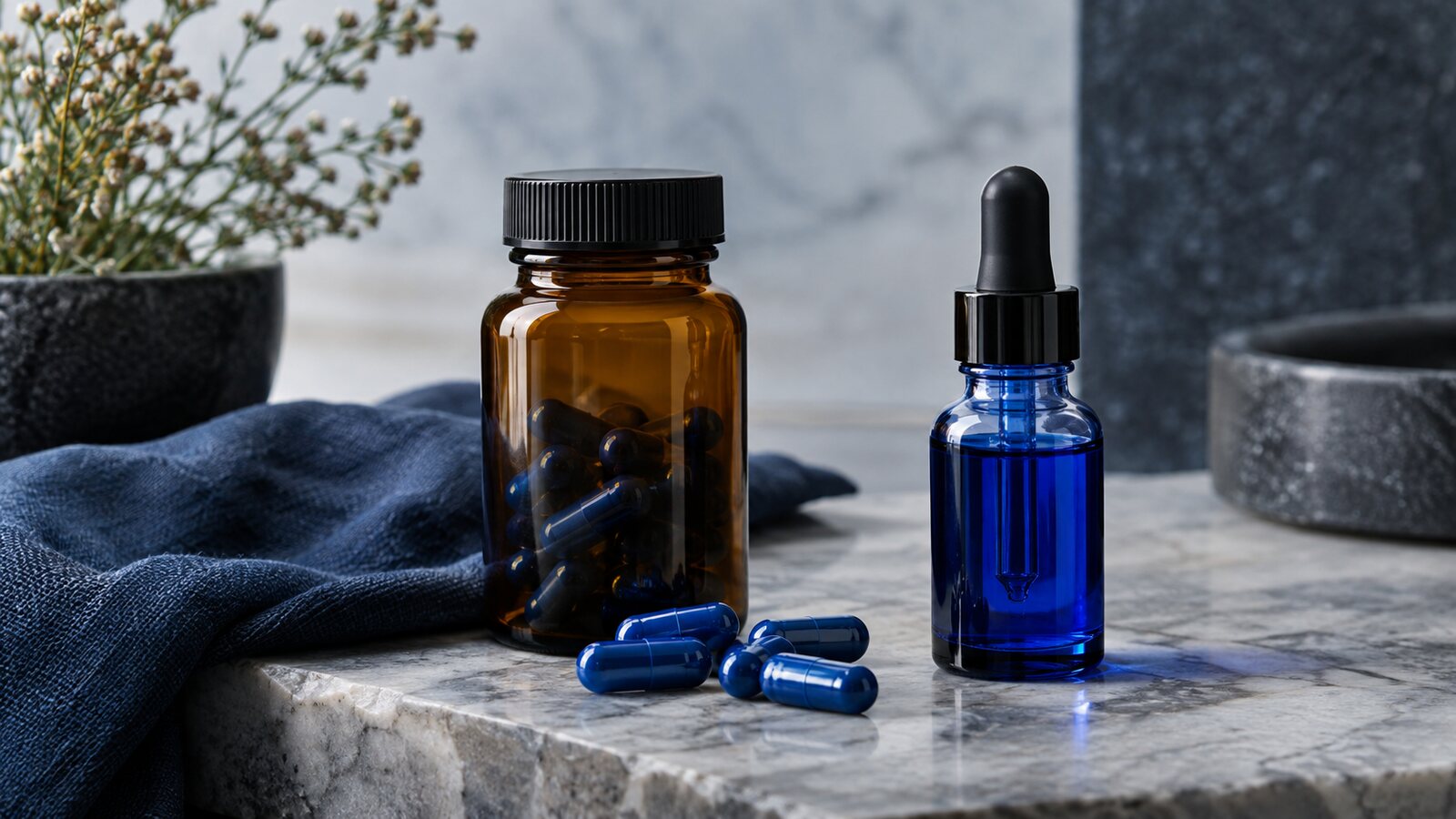
Methylene Blue Capsules vs Liquid: What Should You Compare?
Methylene blue capsules and liquid contain the same core molecule, but they differ in convenience, dose format, measuring error, staining risk, excipients and storage. Neither form is automatically more effective, purer or safer. The more important questions are the intended amount, product documentation, medication interactions and whether the label gives enough information to use the product responsibly.
There are no robust head-to-head human trials showing that a typical consumer capsule is clinically superior to a typical liquid product. Avoid sellers who turn format preferences into guaranteed outcome claims.
The main practical differences
| Question | Capsules | Liquid |
|---|---|---|
| Dose format | Fixed amount per capsule | Depends on concentration and measured volume |
| Measuring | No daily measuring if the capsule matches the intended amount | Requires a clearly stated mg/mL concentration and suitable device |
| Taste and staining | Usually avoids mouth and dropper staining | Can stain the tongue, teeth, hands, surfaces and clothing |
| Portability | Convenient and spill-resistant | Greater spill and leakage risk |
| Excipients | Capsule shell and possible fillers | Solvent, water and possible stabilising ingredients |
| Flexible amounts | Limited by capsule size | Potentially adjustable only when concentration and measuring are reliable |
Start with milligrams, not drops or percentages
A capsule label should state the milligrams of methylene blue per capsule. A liquid should state a concentration such as milligrams per millilitre. A percentage alone can confuse shoppers, while “one drop” is not a universal volume.
For example, two liquid bottles of the same size can have different concentrations. They should not be compared by bottle volume or the blueness of the liquid. A darker appearance is not a reliable test of amount, identity or quality.
If the product relies on drop counting, check whether the supplier has validated the dropper with that exact liquid. Research on liquid dosing devices shows that drop size can vary with tip design, angle and formulation. A calibrated oral syringe is generally more suitable when an exact millilitre volume is required.
Does liquid work faster?
It is tempting to assume that a liquid must act faster because it does not need a capsule shell to dissolve. However, faster disintegration is not the same as a proven meaningful clinical advantage. Formulation, food, dose and individual physiology can all influence absorption.
Unless a seller can provide relevant comparative evidence for the finished products, “faster” and “better absorbed” should be treated as marketing claims rather than established facts.
Capsule quality questions
- How many milligrams are in each capsule?
- What are the capsule shell and other ingredients?
- Is the batch number linked to appropriate identity and impurity specifications?
- Is the bottle light-protective and clearly dated?
- Are medicine interactions and contraindications visible before purchase?
Our South African methylene blue capsule buying guide explains these checks in more depth. It is also worth understanding what a methylene blue COA can and cannot tell you.
Liquid quality questions
- What is the concentration in mg/mL?
- Is the measuring device appropriate and marked in millilitres?
- What solvent and other ingredients are present?
- How should it be protected from light and heat?
- Does the bottle close securely and resist leakage?
- Is the liquid intended for human oral use, rather than laboratory, aquarium, textile or staining work?
Never assume that an industrial or laboratory dye is suitable for ingestion simply because the chemical name appears similar. A blue colour does not establish purity.
Safety does not change with the format
Methylene blue’s major interaction and contraindication questions remain relevant in both forms. The US prescription label for intravenous methylene blue warns about serotonin syndrome with serotonergic medicines and about haemolytic anaemia in people with G6PD deficiency. Oral wellness products have not been established as equivalent to this prescription medicine, but the pharmacological cautions should not be ignored.
If you use an antidepressant, opioid, migraine medicine or other serotonin-affecting substance, read our dedicated guide: Can You Take Methylene Blue With Antidepressants?
Which format is the better buy?
Capsules may suit someone who values a fixed format, travel convenience and less staining. Liquid may suit a context where a properly labelled concentration and calibrated measuring device are specifically needed. The better product is the one with transparent composition, appropriate documentation, a suitable labelled amount and clear safety information—not the one with the louder claim.
Price comparisons should use cost per labelled milligram and number of servings, not bottle size alone. Also check whether a low-priced liquid includes a reliable measuring device and whether a capsule price reflects independent batch documentation.
Frequently asked questions
Are methylene blue capsules stronger than liquid?
Not inherently. Strength depends on the milligrams delivered, not whether the product is dry or liquid.
Do capsules prevent all staining?
They reduce handling and mouth-staining risk, but methylene blue can still colour urine or stool and may stain if a capsule leaks or is opened.
Can I open a capsule to take less?
Do not assume the powder is distributed in a way that makes eyeballing part of a capsule accurate. Follow the label and ask the supplier or pharmacist.
Is a drop always the same amount?
No. Drop volume varies with the bottle, tip, angle, temperature and liquid properties. Use the product’s validated instructions.
Which form is safer with antidepressants?
Neither format removes the interaction concern. The active molecule is the relevant factor.
Educational information only. Methylene blue can have serious interactions and is not a replacement for medical diagnosis or prescribed treatment.
Written by Lize Bührmann, founder of Pharmatropia.
Further reading and editorial review
Continue with the Methylene Blue South Africa guide and the 16mg vs 25mg vs 100mg capsule comparison.
Author and review: Written and reviewed for responsible product information by Dr Lize Buhrmann, Doctor of Natural Medicine and postgraduate-trained in Phytomedicine.
Evidence standard: General ingredient research is not presented as proof for a specific finished product. Read Pharmatropia’s Editorial & Evidence Policy.