Metamorphic Technique: What a Gentle Touch Session Can—and Cannot—Do
Metamorphic Technique is presented as a gentle, non-invasive wellbeing practice using light touch on areas of the feet, hands and head. Practitioners may describe the session in terms of relaxation, self-reflection or creating space for personal change. A responsible explanation also needs to be clear about evidence, consent and limits.
A Metamorphic Technique session should never be sold as a way to diagnose disease, correct spinal problems or guarantee emotional transformation.
What happens during a session?
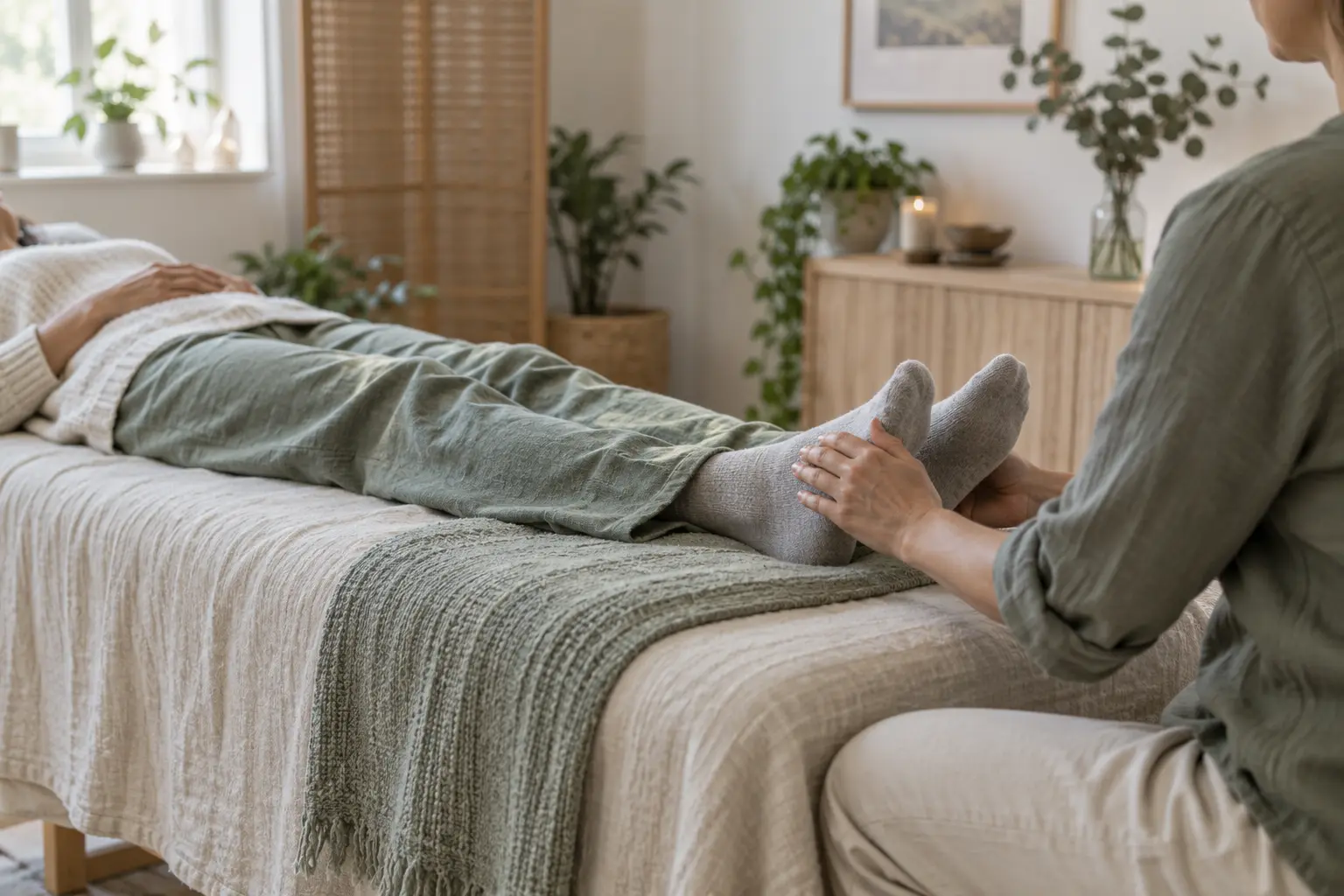
The client usually remains fully clothed and may sit or lie comfortably. The practitioner uses a light touch, often along the inner edges of the feet, hands and parts of the head. Sessions may be quiet, and the client is not expected to disclose personal information unless they choose to.
Some traditions link the touch sequence to symbolic maps of prenatal development or “reflex points”. These ideas are part of the modality’s conceptual history; they are not established anatomical maps or diagnostic tests.
How is it different from massage or reflexology?
- Massage generally works with soft tissue using pressure, movement and established physical techniques.
- Reflexology uses mapped areas on the feet or hands and is often described in relation to other body regions.
- Metamorphic Technique generally uses very light touch and a facilitative, non-directive approach.
None of these labels alone tells you whether a practitioner is appropriately trained, insured or working within scope. Ask directly.
What does the evidence say?
High-quality clinical evidence for Metamorphic Technique is limited. Relaxing in a safe environment, receiving respectful touch and setting aside quiet time may feel beneficial, but that does not prove the modality treats a specific condition.
Personal experiences can be meaningful without becoming universal health claims. Outcomes such as feeling calmer, more reflective or more connected should be described as individual experiences rather than guaranteed effects.
Consent should be active and ongoing
Before a session, the practitioner should explain:
- where touch will occur and whether socks or clothing remain on;
- the expected length and cost;
- that you may pause, change position or stop at any time;
- how notes and personal information are handled;
- what the session does not claim to treat.
Silence is not consent. A good practitioner welcomes questions and does not pressure clients to interpret sensations in a predetermined way.
Who may need adaptations?
Tell the practitioner about foot injuries, recent surgery, painful skin conditions, neuropathy, severe touch sensitivity, pregnancy-related positioning needs or a history that makes touch difficult. A no-touch or self-directed alternative may be more appropriate. Urgent symptoms, unexplained weakness, infection, severe pain or new neurological changes need medical assessment rather than a complementary session.
Questions to ask before booking
- What training and supervised practice have you completed?
- What professional boundaries and confidentiality policy do you follow?
- How do you handle consent and requests to stop?
- What outcomes do you avoid promising?
- When would you refer a client to a healthcare professional?
- Can the session be adapted for disability, sensory sensitivity or trauma history?
How to evaluate the session afterwards
Use simple observations rather than searching for a dramatic meaning. Did you feel safe? Was consent respected? Are you clearer, more settled, unchanged or uncomfortable? Did the practitioner stay within scope? Avoid changing prescribed care because of an interpretation made during a complementary session.
Our guide to combining complementary wellness modalities safely offers a useful framework for coordinating practitioners and avoiding contradictory advice.
Frequently asked questions
Is Metamorphic Technique a medical treatment?
No. It should be approached as a complementary wellbeing practice, not a replacement for diagnosis, psychotherapy, physiotherapy or medical care.
Do I have to talk during the session?
Usually not. You should still feel free to communicate discomfort, request an adjustment or stop.
Can it release trauma?
No practitioner can guarantee trauma release through touch. Trauma symptoms deserve appropriately trained, consent-led mental-health care. A complementary session may feel supportive for some people but should not force emotional processing.
What if I dislike having my feet touched?
Say so before booking. An ethical practitioner should offer an adaptation or confirm that the modality is not the right fit.
Educational information only. Metamorphic Technique is a complementary wellbeing practice with limited clinical evidence. It does not replace medical, psychological or allied-health assessment and treatment.
Written by Lize Bührmann, Doctor of Natural Medicine and founder of Pharmatropia.